In the demanding sphere of commercial infrastructure development and high-end residential construction, electrical engineers and project directors grapple with a persistent, multifaceted dilemma: the requirement to aggressively curtail Lighting Power Density (LPD) while simultaneously sustaining—or ideally augmenting—lux levels and occupant visual comfort. The era wherein one could simply substitute halogen bulbs for generic LED alternatives has definitively passed; the contemporary frontier of specification is defined by ultra-high-efficacy systems where every individual watt is meticulously accounted for to meet stringent energy codes.
For astute importers and wholesalers operating in this volatile market, this technological transition represents a critical pivot point where the decision to source unverified fixtures invites significant operational risk, whereas the specification of engineered, high-performance systems secures professional reputation and ensures project longevity. Bridging this gap between rigorous energy demands and practical implementation requires more than just a vendor; it demands a partner who understands the engineering behind the light.
Anova: From Manufacturer to Solutions Partner
At Anova, we have navigated these profound industry shifts since our inception in 2003, evolving from a manufacturing entity into a comprehensive solutions partner for distinguished global brands. We recognize that authentic sustainability is not merely about utilizing recycled materials—although our Ocean Bound Plastic initiatives are admittedly industry-leading—but fundamentally concerns the engineering of products that endure.
Through the integration of high-performance elements, especially our own MR16 Module 4W High Efficiency module, along with carefully paired drivers, it is possible to provide a conclusive approach to lighting solutions that can greatly lower operational costs. This extensive guide outlines the ways through which identifying an effective high-performance solution can revolutionize results, ensure international standards of energy performance, as well as provide top-class ROI.
Defining the New Benchmark: Why 150lm/W Matters

Shattering the Status Quo with 150lm/W Efficacy
While “brightness” remains a colloquial metric for the uninitiated, professional specification is dictated exclusively by luminous efficacy, a domain where the industry average has stagnated between 80-100lm/W for far too long. Shattering this status quo, the Anova engineering division has achieved a significant breakthrough with the MR16 Module 4W High Efficiency (CB5030GR), a unit that recalibrates performance expectations by delivering a verified 150 lm/W. When one analyzes the implications of this data within the context of a large-scale commercial retrofit, the advantages become mathematically undeniable.
Mathematical Implications for Commercial Retrofits
A conventional 5W LED might have difficulty delivering 400 lumens, while the sophisticated module under discussion requires only 4W to deliver 680 lumens. The efficiency level achieved through the sophisticated module helps designers meet the target light level with fewer light sources or with less total wattage, hence lowering the overall electrical load of the building.
When it comes to a 12-hour operating day, as in the case of a hotel lobby or a commercial store, the effect will be significantly large. This reduction in power consumption, multiplied across hundreds of fixtures and thousands of hours, translates directly to the bottom line.
Uncompromising Color Rendering Capabilities
Furthermore, this 150 lm/W benchmark is not achieved by sacrificing light quality; rather, the module maintains a CRI(Ra) >90, ensuring that the high output renders colors naturally and vibrantly. This rare combination of high efficacy and superior color rendering is often elusive in the commoditized market, making this module the preferred choice for high-end retail and gallery applications where merchandise presentation is absolutely critical. By selecting a module that operates at such exceptional efficiency, you are not merely conserving energy; you are proactively future-proofing the installation against tightening global energy codes and European ErP directives.
The Backbone of Longevity: Precision Driver Matching

The Myth of Diode Failure
A prevalent fallacy within the lighting trade suggests that the LED itself is the primary failure point, whereas empirical data consistently points to the driver or thermal mismatch as the true culprit behind system breakdowns. A high-efficacy module is, in practice, only as reliable as the current that drives it, and to guarantee the operational lifespan of our 4W MR16 architecture, we explicitly mandate the integration of the 125mA 24-40V Triac dimmable LED driver.
Calibrated Precision: The 125mA Advantage
The constant current input of 125mA is calibrated with exacting precision specifically for the 4W module, a crucial matching process that prevents overdriving—a common practice that might squeeze out a few negligible lumens but accelerates junction temperature rise and precipitates rapid lumen depreciation. By strictly regulating the current at 125mA, we ensure the COB chip operates comfortably within its thermal safety zone, significantly extending the product’s operational life.
Eliminating Flicker in Hospitality Environments
For B2B distributors serving the hospitality and residential sectors, the Triac dimmable capability of this driver represents a significant commercial advantage. Flicker remains a persistent pain point in LED dimming, often causing eye fatigue and ruining the carefully curated ambiance of a space. Our drivers are engineered to provide smooth, stable dimming curves compatible with standard phase-cut dimmers, ensuring that whether the setting is a high-end restaurant or a luxury living room, the lighting creates the intended atmosphere without the technical glitches that generate customer complaints. This system-level approach—matching a 150lm/W module with a precision 125mA driver—effectively eliminates the guesswork for contractors and ensures a stable, “install-and-forget” solution.
Modularity: The Engineer’s Strategy for Versatility and Maintenance
Decoupling Light Source from Aesthetic Trim
In an era where flexibility is paramount in architectural design, we staunchly advocate for a sophisticated modular design philosophy that effectively decouples the light source from the aesthetic trim, rendering the rigid, integrated fixture obsolete in flexible architectural applications. This strategic approach offers immense value to wholesalers and project managers by simplifying inventory logistics and streamlining maintenance procedures. Our MR16 Module is meticulously designed to fit a comprehensive array of housings, ranging from fixed downlights to adjustable gimbals, meaning a single stock keeping unit (SKU)—the 4W module—can serve multiple distinct functions.
Unified Specification: The IP65/IP20 Advantage
You can pair it with a deep-recessed anti-glare frame for a hotel corridor or a surface-mounted gimbal for a dynamic art display, a versatility that significantly reduces the inventory pressure on distributors who no longer need to stock dozens of complete fixture variations. Moreover, the IP65/IP20 dual rating of our modules adds another layer of indispensable flexibility. The same 4W module is engineered to withstand dust and moisture, making it entirely suitable for bathroom zones and outdoor eaves as well as dry indoor spaces. This uniformity simplifies the specification process; engineers can specify one single light engine for the entire project, ensuring consistent color temperature and light quality from the lobby to the patio.
Lifecycle Management and the Circular Economy
From lifecycle analysis, modularity aligns well with the ideals of the circular economy. In cases where failure occurs or where renovations require that a new color temperature be used, it will be possible to swap out the module or driver without damaging the ceiling or discarding the housing, which will be an attractive feature for facility managers concerned with efficiency.
Thermal Management and Optical Precision
Die-Cast Aluminum: The Foundation of Durability
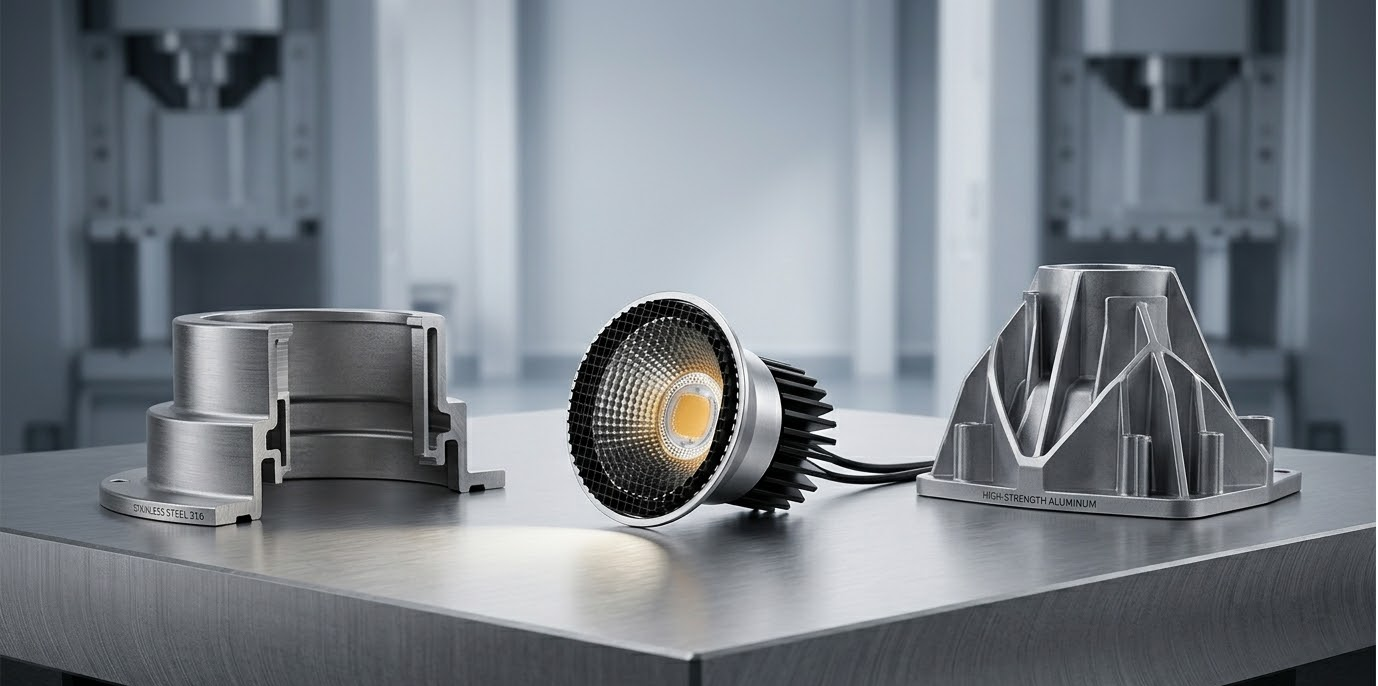
Since thermal deterioration remains an ever-lasting issue affecting the life span of electronic devices, the case of the module has been made from high-density die-cast aluminum with the aim of supporting the ‘Long-Life’ claim incorporated into the design. As opposed to using plastic or stamped-metal materials often found in lower-end offerings, high-density die-cast aluminum provides distinct advantages:
- Superior Thermal Conductivity: Acting as an effective heat sink that quickly removes heat from the junction of the LED.
- Enhanced Durability: Ensuring physical integrity throughout the product’s lifecycle.
- Foundation of Reliability: This robust thermal design is the core feature supporting our 5-year warranty offer.
Sculpting Space with Optical Precision
Beyond mere durability, precision in light distribution is non-negotiable for professional applications, which is why our modules offer interchangeable beam angles of 15°, 24°, 36°, and 60°. This extensive range allows lighting designers to meticulously sculpt the space—using a narrow 15° beam to accent a sculpture or a wide 60° beam for general illumination—without changing the fixture type.
Achieving Visual Comfort and Low UGR
We also address the critical issue of visual comfort; glare can ruin the experience of a space, causing discomfort and eye strain. To combat this, our modules support optional honeycomb louvers, which effectively cut off stray light and significantly reduce the Unified Glare Rating (UGR). For high-end projects, achieving UGR<19 or even lower is often a strict requirement, and our optical design ensures you meet these stringent standards without sacrificing the inherent efficacy of the system.
Anova: Your Partner in Precision Manufacturing
Validation Through Rigorous Laboratory Testing
Defining a product is no small trust in the supplier. Since 2003, Anova has evolved in the worldwide market from a straightforward fabrication company into an extensive technical partner of major worldwide brands in lighting. The company not only assembles parts; it thoroughly validates performance in its own in-house Lighting Lab, confirming that every specification sheet matches real performance. The lab services include extensive photometric analysis to validate the claimed efficiency of 150 lm/W, salt spray testing to validate resistance against corrosion on IP65-rated products, and temperature testing to validate performance at working temperature.
Commitment to Innovation and Responsibility

This data-driven approach allows us to provide the comprehensive IES files and technical reports that engineers absolutely require for simulation and regulatory compliance. We also hold over 50 national patents, a testament to our continuous investment in R&D and our refusal to settle for generic solutions. Our commitment extends deeply into social responsibility through our pioneering “Ocean Bound Plastic” initiative, where we repurpose marine waste into durable lighting components, offering your clients a compelling, verifiable sustainability story.
Certified Supply Chain Reliability
When you partner with us, you gain access to a supply chain certified by ISO9001:2015, ensuring consistency and quality in every single batch produced. With an expedited 8-hour response time from our knowledgeable after-sales team, we ensure that your projects remain on track and fully supported, regardless of the time zone.
Conclusion
Ultimately, the blueprint for specifying high-efficacy, long-life LED systems relies not on a single component, but on the engineered synergy of three critical elements: a high-output engine (150lm/W), a precision-matched driver (125mA), and a versatile, modular mechanical design. By choosing the Anova MR16 Module and driver combination, you are making a calculated choice to specify a system that delivers proven energy savings, exceptional visual comfort, and long-term reliability. We invite you to leverage our engineering expertise and lab-verified data to elevate the performance standards of your next commercial project.
[Explore the Full Technical Specification & IES Files]
[Request a Sample Kit for Your Next Project]
FAQs
Q: How does the modular design of the Anova MR16 system benefit commercial maintenance workflows?
A: The modular design significantly mitigates long-term maintenance costs and reduces environmental waste by allowing for the independent replacement of the LED module or the driver. Unlike integrated fixtures, where the entire unit must be discarded upon failure, our system allows facility managers to perform quick upgrades or repairs without damaging the ceiling or removing the trim, offering a truly sustainable lifecycle.
Q: Can the 4W High-Efficiency Module be effectively utilized in humid locations like bathrooms or outdoor eaves?
A: Absolutely; the module is rated IP65, making it highly resistant to dust ingress and low-pressure water jets. This allows engineers to maintain a consistent lighting aesthetic across a comprehensive project, using the same core module for dry indoor lobbies, humid bathrooms, and even outdoor eaves, thereby simplifying procurement and inventory management.
Q: Why is the 125mA constant current driver critically important for the 4W module’s performance?
A: The 125mA constant current driver is precisely matched to the 4W module’s electrical characteristics to prevent overdriving, which is a common cause of premature LED failure in mismatched systems. This precise current control ensures the LED operates strictly within optimal thermal limits, maximizing its lifespan and maintaining its high 150lm/W efficacy over extended operational periods.