In the realm of commercial and architectural lighting, rigid systems are the enemy of creativity and efficiency. For too long, architects and distributors have been forced to navigate the logistical nightmare of “fixed” luminaires—where the light source and housing are permanently fused. This traditional approach forces distributors to carry bloated inventories to cover every beam angle and color temperature variation, while designers feel restricted by limited aesthetic choices.
The industry is shifting. The future lies in modular lighting systems that decouple the engine from the trim. By adopting a unified core module system, professionals can regain control over their projects. This approach is not merely about convenience; it is a strategic evolution in how we manage light quality, inventory turnover, and environmental impact.
Streamlining Project Efficiency and Inventory Management
For distributors and wholesalers, the “feature-rich” nature of modern lighting can be a double-edged sword. Stocking fixed downlights with varying color temperatures (CCT), beam angles, and IP ratings leads to an explosion of Stock Keeping Units (SKUs). This complexity increases warehousing costs and the risk of dead stock.
The Modular Advantage
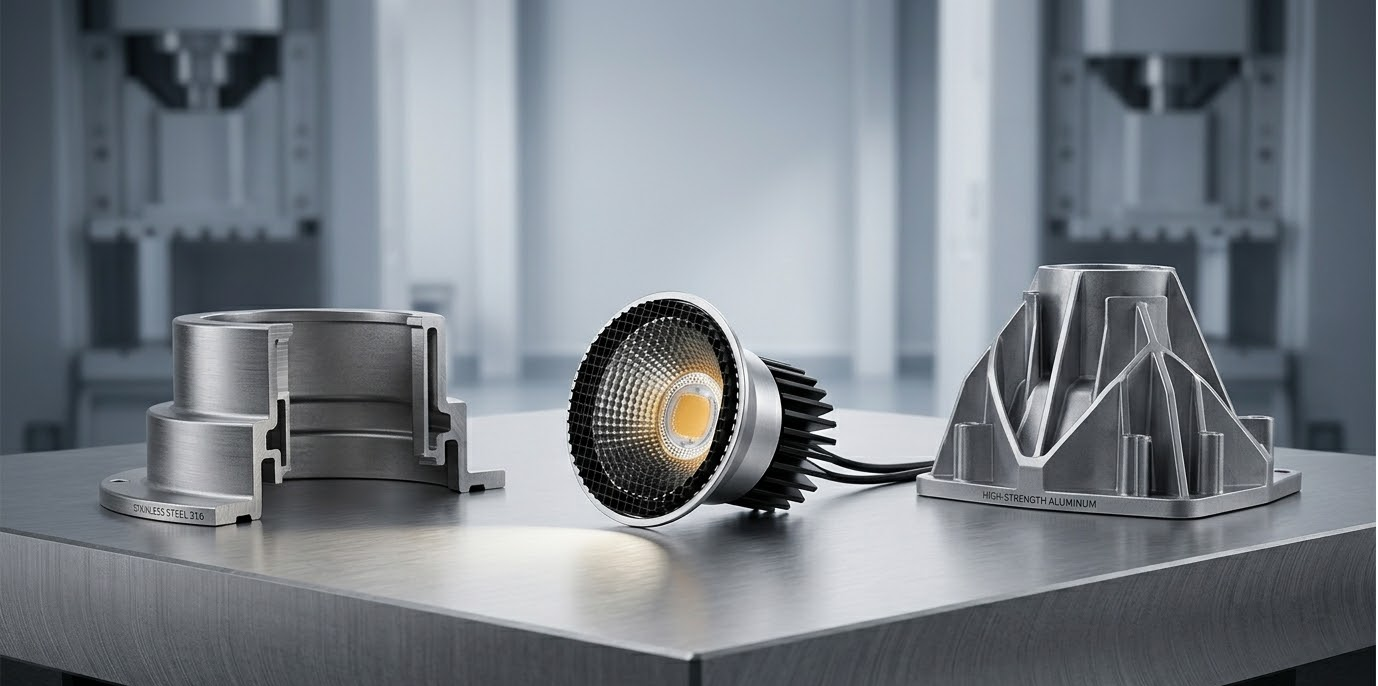
The core module system makes the framework of this equation much simpler. With the standardized connection interface, one LED engine—for instance our MR16 or AR111—can be combined with many different housings (round, square, trimless, or adjustable). This structure delivers targeted benefits for every stakeholder:
- For Importers & Distributors: Reduce SKU complexity by up to 90%. By stocking core engines and trims separately, you maximize inventory turnover and eliminate the financial risk of dead stock caused by unpopular fixed combinations.
- For Contractors & Installers: Eliminate callback costs. The ability to change beam angles or color temperatures on-site means you can adapt to client changes instantly without pausing the project to wait for new fixtures, protecting your labor margins.
- For Lighting Designers: Uncompromised creativity. Achieve perfect visual consistency (CCT/CRI) across wet zones, high ceilings, and corridors using a single reliable light engine source.
Real-World Case Study: One Core, Infinite Possibilities
To illustrate the power of this system, consider a recent commercial hospitality project requiring a cohesive lighting design across diverse environments: a lobby, guest bathrooms, and art corridors.
The Challenge: The project demanded consistent light quality (CCT and CRI) throughout the building, but the physical requirements varied wildly:
- Bathrooms required IP65 water resistance.
- The Lobby needed high-ceiling adjustable spotlights for artwork.
- Corridors required low-glare visual comfort.
The Anova Modular Solution: Instead of sourcing three different fixture models, the solution utilized a single core engine—the 10W Tri-CCT MR16 Module—paired with purpose-built housings:
- In the Bathrooms: The module was fitted into our FD17188H IP65 Recycled Ocean Plastic Housing. This combination provided the necessary waterproof protection and rust resistance (perfect for humid areas) while maintaining the warm 3000K ambiance used elsewhere.
- In the Lobby: The same module was clicked into the LC47404H Surface Mounted Gyro Housing. Its 355° rotation and 30° tilt capabilities allowed the light to be precisely directed at murals and sculptures.
- In Corridors: We utilized the FD16117 Anti-Glare Frame. The deep-recessed design and optional honeycomb filter ensured a soft, glare-free output (UGR<19) for guest comfort.
The Result: The contractor completed the installation with zero color deviation across zones. The facility manager now only needs to stock one type of spare module for the entire hotel, significantly reducing long-term maintenance complexity.
The High-Performance Module Family: Precision Meets Power
The effectiveness of a modular system relies entirely on the quality of its core. We have engineered a comprehensive suite of modules designed to cover every application.
1. 80mm LED MR16 Module 10W Tri-CCT Adjustable

The MR16 format is the backbone of commercial lighting. Our 80mm LED MR16 Module is engineered to replace standard 50mm halogen lamps while offering significantly expanded capabilities.
- Tri-CCT Technology: This module features Tri-CCT Adjustable technology, allowing installers to switch between 2700K, 3000K, and 4000K directly on the unit. This eliminates the need to replace fixtures if the client changes their mind about the “mood” of the room.
- Optical Precision: Available with interchangeable lenses offering beam angles of 15°, 24°, 36°, and 60°, this module provides the precision required for accent lighting.
2. 7W MR11 LED Module | Ø35mm Compact Cabinet Light

When space is at a premium, the MR11 LED Module delivers professional-grade illumination in a miniature footprint.
- Compact Power: With a diameter of just 35mm, this module is specifically designed for cabinet lighting and display niches where bulky fixtures are unacceptable.
- Visual Comfort: Despite its small size, we have prioritized visual comfort. The deep-recessed design options and honeycomb accessories allow for strict glare control, ensuring the light highlights the merchandise, not the source.
3. 14W COB LED AR70 Module & 36W AR111 LED Module
For use in applications requiring high ceilings and more lumens, AR70 and AR111 modules are the best alternatives to conventional Halogen QR111 lamps.
- High-Impact Lighting: The high lumens produced by the 36 W AR111 Module make it suitable for car showrooms as well as up-market retail spaces.
- Advanced Driver Compatibility: The modules are compatible with a variety of dimming systems (DALI, Triac, and 0-10V), making it easy to integrate them with the latest smart building management systems and preventing flicker.
Engineered for Compliance and Sustainability
In the modern B2B landscape, offering a product that performs is not enough; it must also comply with rigorous international standards and sustainability goals.
Validated Quality and Expertise
Trust is built on verification. At our state-of-the-art Lighting Lab, every module undergoes exhaustive testing beyond basic compliance.
- Durability: We conduct salt spray tests and high-temperature simulations to ensure our IP65-rated modules withstand harsh environments.
- Photometric Accuracy: We utilize precise goniophotometers to validate light distribution curves, ensuring that the IES files we provide are 100% accurate for Dialux simulations.
- Certifications: We hold over 50 national patents and essential certifications, including ISO9001:2015, CE, RoHS, and RCS2.0 (Recycled Claim Standard).
Sustainable by Design
Sustainability is a manufacturing philosophy at Anova. The modular nature of our system aligns perfectly with the EU’s Eco-design (ErP) directives. By separating the light source from the trim, we ensure that if a module reaches its end of life, it can be replaced without discarding the entire fixture. Furthermore, we are pioneering the use of Recycled Ocean Plastics in our housing designs, turning discarded fishing nets into durable, heat-resistant lighting components.
Anova: Your Strategic Manufacturing Partner
Since 2003, Anova has undergone a transformation from being a manufacuring organization to becoming a complete partner in lighting solutions. The organization is based in Foshan, which is considered to be the core area of China’s lighting industry, with a clear organizational objective of providing their partners with products that maximize aesthetic appeal without sacrificing functionality.
- International Engagement: This company is focused on serving targeted international markets and is heavily present in Europe, Australia, the Middle East, and Asia. It also shows understanding and meets regional certifications and voltages as required, such as CE, RoHS.
- Supply Chain Resilience: The business maintains strong partnerships with the best component suppliers, such as Bridgelux, OSRAM, and PHILIPS, to enhance the resilience of its supply chains in the face of market dynamics.
By choosing Anova, you are not just buying an LED module; you are securing a partnership dedicated to your long-term growth.
Conclusion
The future of architectural lighting is defined by flexibility. A Unified Core Module System—encompassing MR16, MR11, AR70, and AR111 formats—liberates designers from the constraints of fixed luminaires and relieves distributors from the burden of excessive inventory. As demonstrated in our hospitality case study, this approach maximizes design freedom while ensuring operational efficiency. Whether you are illuminating a boutique display or a sprawling commercial complex, Anova’s modular solutions provide the precise, high-quality light foundation you need to succeed.
Ready to transform your lighting inventory and design capabilities? Experience the precision of Anova’s unified core modules firsthand. Contact us today to request a sample, or download our full product catalog and IES files to start planning your next project.
FAQs
Q: Can I use different IP ratings (IP20 and IP65) within the same project while maintaining a consistent look?
A: Yes, this is a core strength of our modular system. As highlighted in the hospitality case study, you can select our IP65-rated modules or housings for wet areas like bathrooms and standard IP20 versions for corridors or lobbies. Because they share the same LED core technology, you achieve perfect visual consistency in color temperature and light quality throughout the entire building, regardless of the environmental protection required.
Q: How does the Tri-CCT Adjustable feature on the MR16 module benefit installers?
A: The 80mm LED MR16 Module offers critical on-site flexibility. Installers can toggle between 2700K, 3000K, and 4000K directly on the unit. This capability is invaluable during final commissioning: if a client prefers a warmer or cooler ambiance than originally specified, adjustments can be made immediately. This eliminates the need for costly product returns or re-ordering, significantly streamlining project handovers.
Q: Are the high-power AR70 and AR111 modules compatible with commercial dimming systems?
A: Absolutely. Engineered for smooth integration with today’s Building Management Systems (BMS), our AR70 and AR111 modules incorporate advanced drivers that are compatible with DALI, Triac, and 0-10V systems. This allows for flicker-free and stable operation of intelligent lighting networks typically used in museums, showrooms, and high-end retail environments.