High-latitude residential architecture often reduces the Swedish vernacular of Mys to a decorative affectation of organic textures. This is a fundamental error.
For the principal architect, Mys constitutes a rigorous photometric countermeasure against circadian desynchronization caused by extreme solar variances. It is a physiological necessity, not an aesthetic choice, mitigating prolonged scotopic conditions inherent to Nordic winters.
A prevalent technical deficiency in modern specifications involves the misalignment between architectural materiality and photonics. High-grade minimalist joinery fails to achieve spatial coherence when paired with illumination infrastructure lacking spectral agility. In environments with negligible natural daylight, the precise modulation of Correlated Color Temperature (CCT) is a critical biological imperative governing occupant habitability.
Static LED topology is functionally obsolete in these sophisticated environments. The rigid specification of singular chromaticities—whether clinical 4000K or monotonic 3000K—imposes artificial stasis on dynamic living spaces. While often categorized under the broad umbrella of warming dimming curves, achieving the true Swedish ‘Mys’ requires the precision of Tunable White architecture. We specify the strategic deployment of high-fidelity modular engines, specifically the 2700-6500K Tunable White 7W MR16 LED Module. Engineering an illumination profile that approximates the solar locus transforms residential envelopes into adaptive, human-centric systems.
Photometric Parameters: Spectral Power Distribution and CRI Fidelity
Operationalizing Nordic design principles requires mastering spectral power distribution (SPD) beyond elementary datasheet metrics. Circadian entrainment demands specific melanopic stimulus via intrinsically photosensitive retinal ganglion cells (ipRGCs) during diurnal phases, followed by rigorous suppression of short-wavelength emissions post-sunset. Standard residential tenders systematically deprioritize this photobiological requirement for installation expediency. Authentic execution of the Swedish aesthetic demands a calibrated equilibrium where artificial illumination renders space with organic naturalism.
Physiological alignment necessitates dynamic spectral manipulation. Static chromaticity is biologically incongruent with human physiology. While standard Dim-to-Warm technology mimics the redshift of halogen filaments, Tunable White elevates this concept, providing the granular control essential for multi-functional living. It decouples luminous intensity from chromaticity, permitting independent modulation via sophisticated driver topologies. This separation allows for the optimization of Melanopic Equivalent Daylight Illuminance (mEDI), ensuring that high-intensity output does not inadvertently trigger melatonin suppression during evening hours unless specifically calibrated for alertness.
- Diurnal Profile: The system must generate a high-intensity, short-wavelength-enriched spectral output (specifically targeting the 460-490nm melanopic sensitivity peak) within the 4000K-6500K CCT range. This configuration is engineered to maximize ipRGC excitation, thereby suppressing melatonin synthesis and promoting cortisol secretion to align the occupant’s circadian phase with the solar cycle. This is essential for maintaining cognitive vigilance and neurobehavioral performance during photopic hours.
- Nocturnal Profile: A shift to melatonin-supporting 2700K facilitates physiological decompression, minimizing blue-light hazard functions while maintaining adequate visual acuity for task performance.
Chromaticity is only one variable. Swedish interiors are defined by materiality—raw oak, unbleached linen, natural stone. Low Color Rendering Index (CRI) sources flatten and desaturate these textures, negating investment in premium finishes. Anova enforces strict technical standards, prioritizing LED engines with CRI >90 and R9 values >50. Subtle timber grain and textile weaves require museum-grade fidelity to be perceived correctly; spectral deficiencies in the red portion of the spectrum inevitably result in a sterile, clinical pallor unacceptable in residential contexts.
The Technological Core: 2700-6500K Tunable White 7W MR16 LED Module

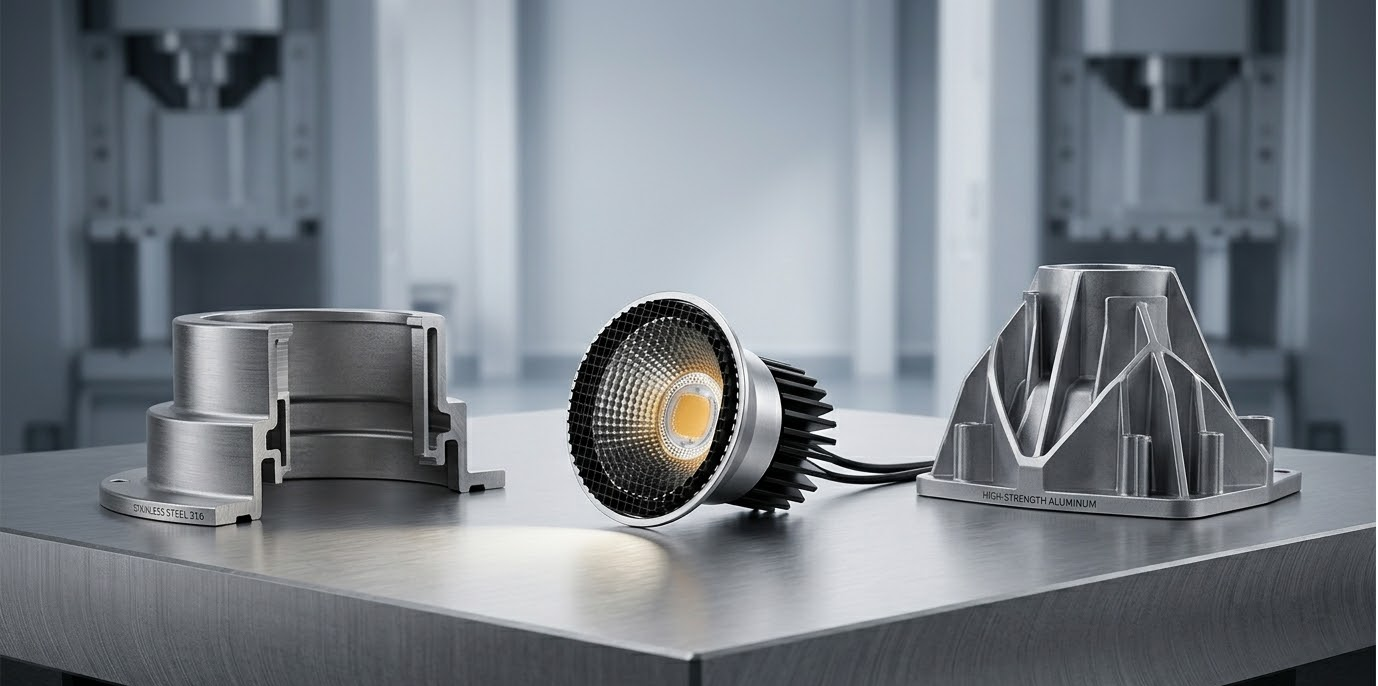
System integrity relies on the photometric stability of the photonics engine. The VB5050TWL is a 2700-6500K Tunable White 7W MR16 LED Module engineered for the tolerances of architectural applications. Distinct from mass-market retrofits subject to rapid lumen depreciation, this component is designed for thermal longevity and luminous consistency (SDCM <3).
Technical Specifications:
- Architecture: Stabilized 24V DC. Critical for seamless integration with smart home ecosystems (DALI, 0-10V, Zigbee) and emerging solar-powered DC grids. This low-voltage architecture mitigates voltage drop issues in extended circuit runs and enables compatibility with centralized constant voltage drivers, decoupling the thermal load of power conversion from the light source itself.
- Thermal Management: Thermodynamic equilibrium is maintained via a high-density die-cast aluminum heat sink. This passive cooling structure ensures the Junction Temperature (Tj) remains significantly below the LED phosphor degradation threshold, guaranteeing L70B50 longevity benchmarks exceed 50,000 hours even within insulated plenum environments.
- Form Factor: Compact 50mm height resolves installation conflicts in shallow ceiling voids common in renovation projects or architectural designs prioritizing maximized floor-to-ceiling heights.
- Output: 593lm to 665lm. Calibrated for general illumination and focused “pools of light,” adhering to Scandinavian contrast preferences.
- Optical Versatility: Photometric distribution is governed by interchangeable Total Internal Reflection (TIR) optics, offering defined beam angles of 15°, 24°, 36°, and 60° (Full Width at Half Maximum – FWHM). This modularity permits granular on-site commissioning: narrow-beam collimators maximize center-beam candlepower (CBCP) for accentuating architectural details, while wide-beam variants ensure uniform illuminance on vertical surfaces. The optical assembly is engineered to minimize spill light and secondary glare rings.
- Visual Comfort: Glare mitigation follows rigorous Unified Glare Rating (UGR) standards. The module integrates seamlessly with an optional honeycomb louver accessory, effectively cutting off high-angle luminance and reducing the UGR to <19 in typical installations. This ensures the light source remains unobtrusive (“dark light” effect). With IP20 and IP65 ingress protection ratings, design continuity is maintained across diverse zones.
- Dimming Topology: The driver architecture supports high-frequency Pulse Width Modulation (PWM) operating >3000Hz or hybrid Constant Current Reduction (CCR) protocols. This topology ensures flicker-free performance (IEEE 1789 compliant) even at deep-dimming levels (<1%), eliminating stroboscopic artifacts that can induce visual fatigue or interfere with digital imaging sensors.
Modular Design: Supply Chain Engineering and Lifecycle Assessment

Supply chain optimization mandates a modular architecture to resolve the conflict between SKU proliferation and inventory liquidity. The strategic modular design of the MR16 LED engine addresses this by physically isolating the light source (module) from the trim (housing). One high-performance engine pairs with hundreds of frame styles—round, square, trimless, tilted, fixed.
Key Advantages:
- ErP Compliance: Aligns with EU Ecodesign directives regarding reparability and circular economy principles. Failure in the LED component does not necessitate disposal of the entire unit (heatsink, bezel, clips). Only the LED engine is replaced, significantly extending the installation lifecycle and minimizing electronic waste streams (WEEE). This modularity improves the product’s Reparability Index, a metric increasingly scrutinized in European public tenders.
- Sustainability: Ideally paired with proprietary Recycled Ocean Plastic Downlight Housings. Manufactured from discarded maritime plastics (ghost fishing nets), offering structural durability and UL94 V-0 fire safety compliance with a reduced carbon footprint. The polymer matrix exhibits high tensile strength and thermal stability comparable to virgin polycarbonate, validating its suitability for rigorous architectural applications without compromising mechanical integrity.
Integrating a Tunable White module inside a recycled ocean plastic frame creates a compelling narrative: a high-tech, human-centric solution actively contributing to environmental remediation.
Anova: Vertical Integration and Manufacturing Protocols
Established in Foshan’s photonics cluster in 2003, Anova operates as a vertically integrated ODM partner. Manufacturing protocols adhere to ISO9001:2015, utilizing automated photometric testing to ensure batch-to-batch consistency.
Commitment to engineering excellence is substantiated by a state-of-the-art Lighting Lab. Every product series undergoes exhaustive evaluation: detailed photometric analysis using goniophotometers, extreme temperature stress testing in environmental chambers, and salt spray testing for corrosion resistance. Durability is vital for coastal or humid regions where saline aerosols accelerate galvanic corrosion.
The supply chain is optimized for reliability. Delivery adherence is critical. Whether requiring bespoke ODM services manufacturing, execution is precise.
Conclusion
Engineering an authentic Swedish living room necessitates a precise equilibrium of photometric metrics. The transition from static, single-color lighting to dynamic Tunable White systems is a necessary evolution. By integrating the 2700-6500K Tunable White 7W MR16 LED Module, professionals deliver spaces that are visually coherent and biologically supportive.
Coupled with sustainable, modular housing options, these solutions offer a tangible value proposition: superior light quality (CRI>90), future-proof maintenance, and verifiable environmental stewardship.
Contact Anova today for full IES files, detailed specifications, or sample orders for Tunable White MR16 Modules.
[Enhance project specifications with high-performance, sustainable lighting solutions.]
FAQs
Q: What are the thermal advantages of the 24V DC architecture?
A: The 24V DC input architecture separates the power supply thermal load from the LED junction. Unlike AC LEDs with bulky, heat-generating drivers at every fixture, 24V DC systems permit centralized remote driver configurations. This isolates the heat source, enhancing thermal management and MTBF. It also enables smoother, flicker-free dimming (deep dimming <1%).
Q: Is the 7W Tunable White Module compliant for high-humidity zones?
A: Yes. The robust IP65-rated version is dust-tight and protected against low-pressure water jets, compliant for bathrooms, showers, or exterior eaves. This allows photometric continuity from interior to exterior envelopes without changing fixture typology.
Q: How does modular design impact inventory logistics?
A: Modular design rationalizes inventory (SKU reduction). Distributors stock MR16 LED Modules (engines) and various Frames (housings) separately. This enables on-demand assembly of thousands of combinations, optimizing stock turnover. It also inherently supports ErP directives by ensuring light source replaceability.