In modern architectural applications—from luxury superyacht cabins to high-end retail cabinetry—the trend is undeniable: ceiling voids are shrinking. Designers are pushing for maximized vertical height, often leaving lighting engineers with plenum depths of less than 50mm.
While aesthetically pleasing, these “low-clearance” zones create a thermal trap. For engineering contractors and lighting distributors, the challenge is not merely fitting a fixture into a tight aperture; it is ensuring the LED engine survives without airflow.
This deep dive explores the thermodynamics of restricted plenums and details how the 4W 30mm Ultra Thin SunLike LED MR16 Module utilizes die-cast engineering to conquer these hostile thermal environments.
The Physics of the “Thermal Trap”
To understand why standard modules fail in tight spaces, we must look at the physics of heat transfer. Traditional LED downlights rely on convection. In a spacious ceiling (100mm+ void), air circulates the heat sink, carrying thermal energy away from the junction point.
In a confined space—such as a 35mm gap in a yacht bulkhead or a sealed joinery unit—air becomes stagnant, effectively creating a zero-airflow environment. In this thermodynamic scenario, the localized ambient temperature (Tamb) rapidly escalates to reach equilibrium with the heat sink, drastically reducing the temperature differential (△T) essential for convective heat transfer. This “thermal saturation” causes energy to accumulate at the junction point rather than dissipate, leading to a breakdown in the thermal management system.
The Engineering Consequences: Without a specialized thermal solution, the uncontrolled rise in junction temperature (Tj_max) precipitates driver electrolytic capacitor failure and phosphor degradation, manifesting as permanent color shift and, in combustible joinery applications, presenting a critical fire safety risk.
The Solution: Conduction Over Convection
At Anova, we recognized that in zero-airflow environments, you cannot rely on air movement. You must rely on conduction. This necessitated a complete re-engineering of the MR16 form factor, resulting in the 4W 30mm Ultra Thin SunLike LED MR16 Module (CB5030QL).

1. Die-Cast Aluminum Body: The Thermal Bridge
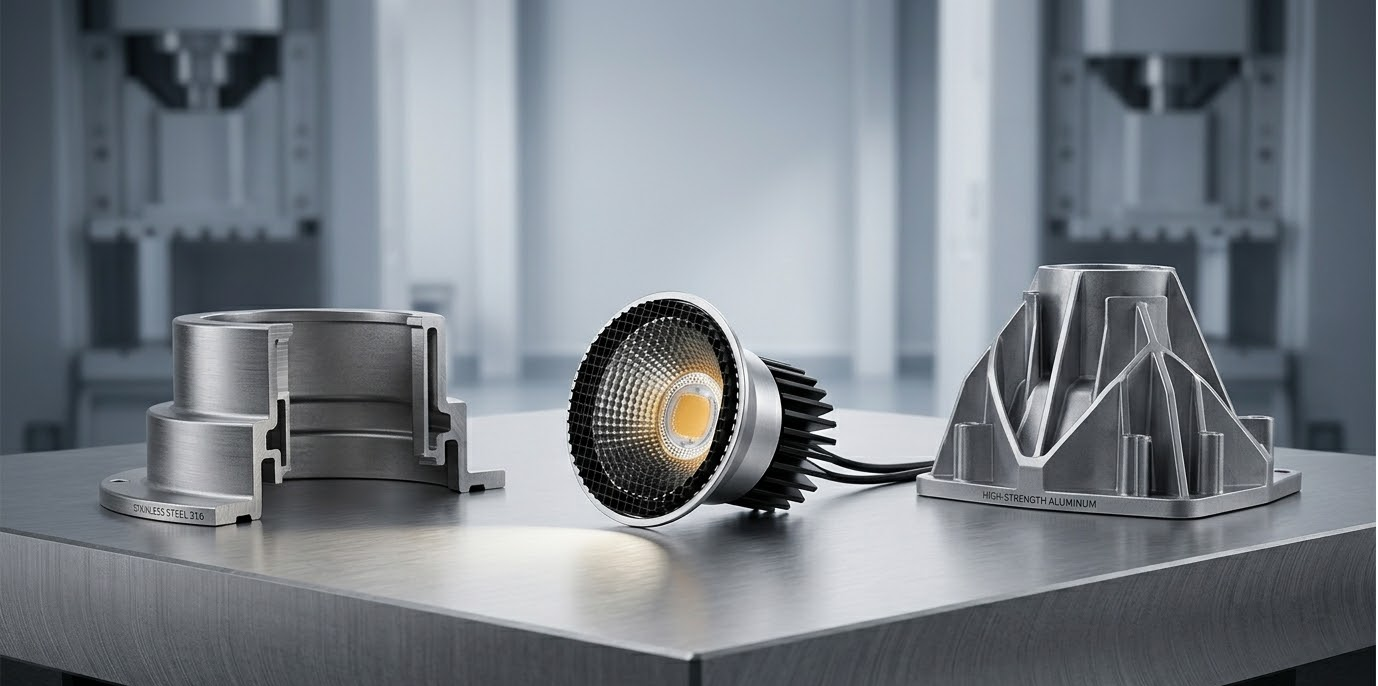
Many ultra-thin modules on the market compromise by using thermal plastic or hybrid housings to save weight, which effectively insulate the core and traps heat. In contrast, the CB5030QL utilizes a 100% Die-Cast Aluminum chassis with superior thermal conductivity to establish a rapid thermal bridge. This conductive pathway efficiently draws waste heat away from the COB chip and dissipates it into the fixture trim and surrounding structural elements, ensuring that the junction temperature remains strictly within L70 parameters even within a stagnant 40mm void.
2. The 30mm Form Factor Advantage

Standard MR16 modules typically range from 50mm to 80mm in height, which can dangerously choke the available air volume in shallow ceilings. Our precision-engineered 30mm profile not only facilitates installation in ultra-tight 35-40mm plenums but also strategically preserves a “thermal breathing zone” above the fixture. This critical spatial allowance accommodates electrical cabling and mitigates conductive heat accumulation against the upper slab, creating a safety margin that is physically unattainable with conventional taller form factors.
3. Calibrated Power Density (4W & 125mA)
A high wattage and low footprint are prone to system failure, and the attempt to drive 7W or 10W into a 30mm heat sink without active cooling is a thermal safety violation. This module has been precisely calibrated to run conservatively at 4W with a constant current input of 125mA, which strikes an optimal balance between the luminous flux produced and the thermal load. This under-driven configuration ensures the LED phosphor and electronic components are not thermally stressed, thus maintaining chromatic integrity and longevity regardless of the ambient temperature in the plenum.
Visual Comfort and Environmental Resilience
While heat dissipation is the engineering priority, light quality remains the design priority.
SunLike Full Spectrum Technology: Thermal management should not come at the cost of light quality. We utilize SunLike COB technology to mimic the spectrum of natural daylight, ideal for high-end retail displays where color fidelity (CRI >90) is critical, or residential spaces where blue-light spikes from standard LEDs can disrupt circadian rhythms.
IP65 Protection for Marine & Wet Areas. Confined spaces often come up in challenging environments, such as yacht heads (bathrooms) and exterior soffits. The CB5030QL has been designed to offer an IP65 rating, which includes a die-cast enclosure that is completely sealed against dust and water jets. This level of sealing against moisture reduces the problem of corrosion within the driver, often an issue for marine environments, and offers an extra level of reliability beyond thermal management.
Anova: Validation Through Rigorous Testing
Since 2003, Anova has been a strategic partner to global lighting brands, not just a factory. We validate our thermal engineering claims through our in-house Lighting Lab.
Before any module reaches your warehouse, it undergoes:
- Temperature Rise Testing: We simulate confined ceiling conditions to verify the heat sink’s saturation point.
- Salt Spray Testing: Ensuring the aluminum body resists corrosion in marine applications.
- Aging Tests: Extended burn-in periods to screen for early mortality.
We don’t just guess that the light will survive in a tight space; we prove it with data.
Conclusion
For lighting importers and contractors, the “install and forget” reliability of a fixture is paramount. In confined ceiling spaces, this reliability is strictly a function of thermal engineering. By prioritizing die-cast aluminum construction, a 30mm ultra-thin profile, and calibrated power density, the 4W SunLike MR16 Module solves the heat dissipation equation.
Eliminate the risk of overheating and premature failure in your next project. Choose a module engineered for the reality of modern architectural constraints.
Ready to secure your supply chain?
FAQ
Q: What is the absolute minimum void depth required for the 4W 30mm module?
A: The height of the module is 30 mm. The recommended minimum depth for voids is 35–40 mm. This space is required for electrical connection and also ensures that there is no direct contact between the heat sink and the top slab, thus making it safe for thermal conduction.
Q: What are the reasons for choosing die-cast aluminum instead of plastic for this module?
A: In an enclosed space without air circulation, heat dissipation occurs only through conduction. Aluminum is an excellent conductor of heat, and plastic is an insulator. The die-cast aluminum actively removes heat from the chip, thus preventing overheating and failure of the LED chip.
Q: Can this module be dimmed?
A: Yes. The module has a constant current supply of 125mA. It can work with many different types of external dimmable drivers (Triac, 0-10V, and DALI) to enable its seamless integration into smart control systems for hotels and luxury homes.