Use the finest LED downlights to gain a competitive edge in the market. This professional guide aims to provide expert advice on selecting LED downlights while explaining why Anova, with its innovative lighting solutions like high-efficiency round LED downlights, is your ideal partner.
LED Downlights: Technical Principles & Core Advantages
LED downlights, essential recessed fixtures in modern architecture, are the top choice. They deliver remarkable energy savings, precise light output, and extended longevity. Their main light-emitting component is the semiconductor diode. This ensures excellent performance, slow light decay, quick response, and avoids toxic materials. It supports eco-friendly building standards. Anova’s downlight series features adjustable color options and intelligent controls. These blend effortlessly into diverse environments, from corporate offices to upscale residences.
Key LED Downlight Technical Parameters
Illuminance (Lux) & Luminous Flux (Lumens)
· Target Illuminance (Lux): The desired brightness on a surface. It acts as the primary measure in lighting design. Various spaces and tasks require specific levels. For instance, office areas recommend 300-500 Lux. Premium retail highlight zones may demand higher.
· Luminous Flux (Lumens): The total light produced by a source over time. It gauges a fixture’s light output strength. Calculations consider room size, ceiling height, surface reflection, and needed illuminance to determine required flux. Anova provides detailed photometric data to assist professional planning.
Color Temperature (CCT) & Color Rendering Index (CRI)
1. Correlated Color Temperature (CCT): Measured in Kelvin (K), it defines the light’s hue. Selecting the appropriate CCT shapes atmosphere and influences mood and efficiency.
·Warm White (2700K-3000K): Creates a snug, relaxing vibe. It’s perfect for hotels and homes.
·Neutral White (3500K-4000K): Provides a clear, lively glow. It’s suitable for offices, stores, and classrooms.
·Cool White (5000K-6500K): Fosters a crisp, focused environment. It fits industrial sites or laboratories. Anova’s tunable white downlights let users tweak light color for different times or purposes.
2. Color Rendering Index (CRI): Gauges how faithfully a light shows object colors. A higher CRI (up to 100) means more accurate color display. For color-sensitive settings like shops or galleries, opt for CRI ≥90. Anova’s high-end downlights achieve CRI above 90.
Beam Angle & Light Distribution Curve
Beam Angle: The width of emitted light. Different angles suit distinct purposes:
Narrow Beam (10°-24°): Produces focused, intense light. It’s great for spotlighting or tall ceilings.
Medium Beam (36°-60°): Balances highlighting and general lighting. It’s highly adaptable.
Wide Beam (>60°-120°): Offers uniform, expansive illumination. It’s ideal for general lighting or short ceilings.
Light Distribution Curve: Details light strength across directions. It’s crucial for accurate lighting control. Anova supplies photometric files in IES formats to aid design simulations.
Efficacy, Lifespan & Intelligence
Driver Power Supply: The heart of an LED downlight. Its quality impacts durability, consistency, and efficiency. Choose efficient drivers with safeguards for temperature, voltage, and current.
Dimming Performance: Pick dimming methods like 0-10V, DALI, TRIAC, or wireless smart options (e.g., Zigbee, Bluetooth Mesh) based on project requirements. Anova’s downlights support multiple dimming protocols.
Lifespan & Lumen Maintenance: Review L70/B50 metrics. These indicate when light output stays at 70% or higher, with no more than 50% of fixtures failing. Anova uses premium diodes and thermal designs for lasting dependability.
| Technical Parameter | Professional Consideration & Application Value |
| Target Illuminance (Lux) | Ensure sufficient and comfortable light levels based on space function and industry standards. |
| Luminous Flux (Lumens) | Accurately calculate via lighting design software, considering spatial characteristics and illuminance needs, to avoid over or under-illumination. |
| Color Temperature (CCT) | Create specific spatial ambiances, influence human physiological and psychological responses; fixed or tunable CCT options available. |
| Color Rendering Index (CRI) | Guarantee true color reproduction, crucial for commercial displays, art lighting, etc.; recommend CRI≥80, ≥90 for high-end applications. |
| Beam Angle | Achieve precise light control, differentiate between accent and ambient lighting, optimize visual hierarchy. |
| Light Distribution Curve | The foundation of professional lighting design for accurate simulation and prediction of lighting effects. |
| Drivers & Dimming | Ensure system stability, energy efficiency, and intelligent control, enhancing user experience and management convenience. |
| Lifespan & Lumen Maintenance | Reduce maintenance costs, guarantee long-term stable lighting effects; a key indicator for assessing long-term product value. |
LED Downlight Sub-Types & Best Practices in Engineering Projects
Selecting the appropriate LED downlight type is crucial for meeting the specific needs of diverse engineering projects:
- Fixed vs. Adjustable/Gimbal Downlights:
- Fixed Downlights: Provide direct downward illumination for general ambient lighting in large areas.
- Adjustable Downlights (e.g., single/double gimbal downlights): The luminaire head angle can be flexibly adjusted to precisely direct light onto specific objects or wall surfaces, often used for accent lighting, wall washing, or installations on sloped ceilings. Anova’s adjustable downlight series offers various adjustment angles and beam options.
- Recessed vs. Surface-Mounted Downlights:
- Recessed Downlights: The luminaire body is fully recessed into the ceiling, integrating seamlessly with the architecture for a clean, modern aesthetic; the mainstream choice for commercial and residential spaces.

- Surface-Mounted Downlights: The luminaire body is installed directly onto the ceiling surface, suitable for solid ceilings, locations where openings are not feasible, or where ease of installation is a priority, such as industrial plants, parking garages, or some retrofit projects. Anova’s surface-mounted downlight series balances aesthetics and practicality.

- IP (Ingress Protection) Rated Downlights
For areas with moisture, water, or dust, such as bathrooms, kitchens, semi-outdoor zones, or cleanrooms, downlights with appropriate IP ratings should be selected. For example, IP44 is suitable for damp locations, while IP65 can be used in areas subject to water jets or outdoor eaves. Anova offers a range of IP-rated downlights to ensure safe and stable operation in demanding environments.
LED Downlight Installation Standards & Project Management Essentials
- Pre-Construction Preparation
Review lighting design plans and fixture manuals carefully. Verify ceiling materials, cutout sizes, wiring specifications, and driver space meet requirements. - Safety First
Follow electrical safety protocols strictly. Disconnect circuit power before installation. Ensure certified electricians perform all tasks. - Precise Positioning & Cutouts
Mark positions accurately per plans. Use proper tools for smooth, correctly sized cutouts. Avoid ceiling structural elements, pipes, or conduits. - Standardized Wiring
Connect live, neutral, and ground wires securely. Use professional connectors and insulate joints properly. Place drivers in ventilated, accessible spots. Avoid covering them with insulation to prevent overheating. - Luminaire Fixing
Fasten downlights to the ceiling using spring clips or other mechanisms. Ensure they are stable and wobble-free. - System Commissioning
Test power-on after installation. Check for correct lighting, no flickering, and smooth dimming. Configure smart control systems as needed. - Project Acceptance & Documentation
Verify lighting effects meet project standards. Compile and store fixture specs, installation plans, and test reports for future reference.
Lighting Design for Spatial Value & User Experience with LED Downlights
Skilled lighting design optimizes LED downlights. It boosts the commercial worth of spaces and improves user satisfaction.
- Integration with Architecture & Interior Design
Choose fixtures that align closely with architectural style, interior decor, and layout. Anova provides downlights in diverse shapes, sizes, trim colors, and materials. These suit varied design needs. They create a balanced blend of light and space. - Creating Multi-Layered Light Environments
Combine downlights with different types, beam angles, and brightness levels thoughtfully. This builds layered light settings. For example, blend ambient, accent, and decorative lighting. It meets varied visual and practical needs. - Focusing on Visual Comfort & Healthy Lighting
Select downlights with effective anti-glare features. Examples include deep-recessed sources, special reflectors, or lenses. These control Unified Glare Rating (UGR) and reduce discomfort from bright light. Prioritize healthy lighting traits like flicker-free operation and low blue light risk. Anova develops products with excellent visual comfort.
Partnering with Anova: Co-Creating New Commercial Value in LED Downlighting
Anova is more than a supplier of LED downlights; we are your trusted business partner, dedicated to creating exceptional value for lighting wholesalers and engineering firms.
Product Competitiveness: Technological Leadership & Quality Assurance
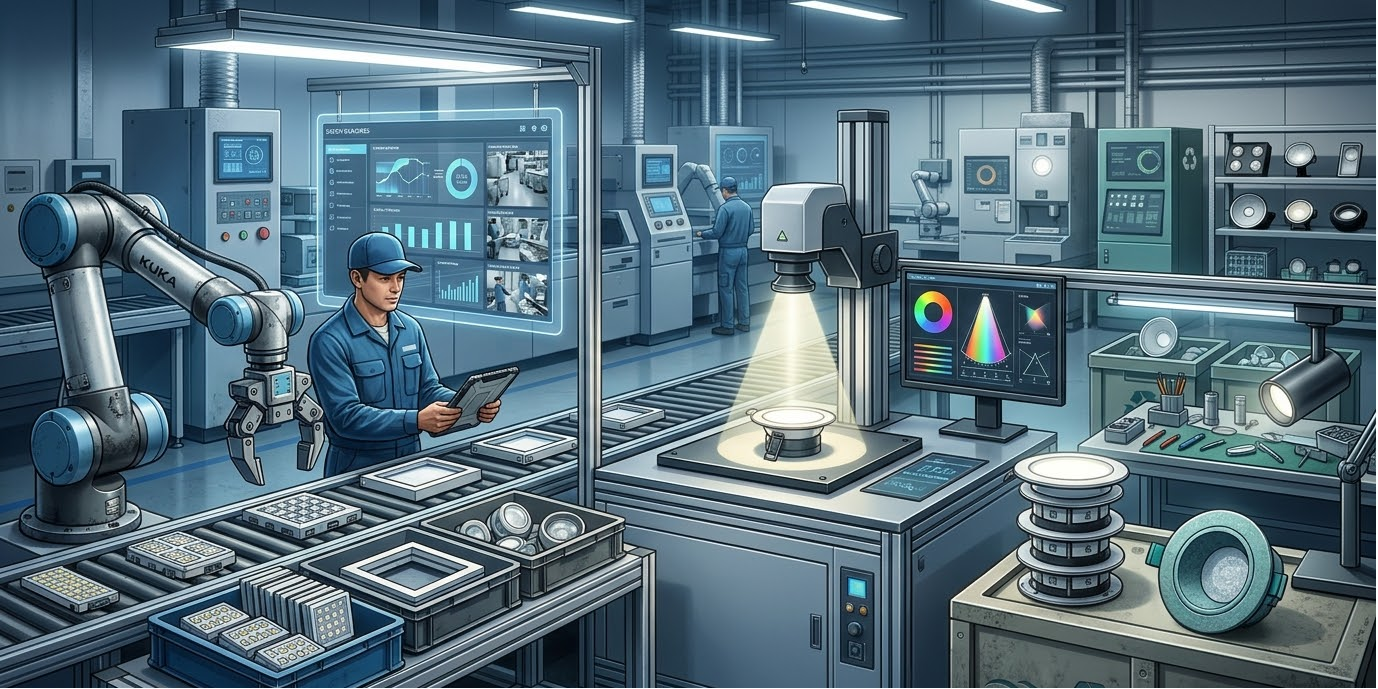
Anova continuously invests in R&D, adopting advanced LED technology and environmentally friendly materials (e.g., using recycled ocean plastic in some products) to ensure industry leadership in luminous efficacy, lifespan, reliability, and intelligence. A strict quality control system permeates every stage, from raw material procurement to finished product AQL inspection.
Supply Chain Advantages: Stable Supply & Cost-Effectiveness
We possess efficient production management and supply chain systems, guaranteeing stable supply for large-volume orders and rapid response times. Through economies of scale and cost optimization, we provide partners with a competitive pricing structure.
Professional Support: Technical Services & Project Collaboration
Anova boasts an experienced technical support team that can provide product training and selection guidance for wholesalers, and assist engineering firms with lighting scheme design, illuminance simulation calculations, and on-site project commissioning. We offer comprehensive product documentation, IES files, installation guides, and after-sales service.

Market Empowerment: Brand Cooperation & Value Co-Creation
We view our partners as strategic allies for mutual growth. Through marketing support, project information sharing, and other initiatives, we empower partners to expand their business, enhance brand influence, and jointly tap into the vast potential of the LED lighting market.
FAQs – For Wholesalers & Engineering Firms
Q: How can we recommend the most cost-effective Anova LED downlight series to clients based on project budget and performance requirements?
A: Anova offers varied LED downlight series for different budgets and needs. Our teams assist with product comparisons. They consider project specifics like site, illuminance, CRI, controls, and lifespan. We suggest optimal, cost-effective solutions with specs and quotes.
Q: For specific projects (e.g., hotels, office buildings, high-end retail), does Anova have recommended typical LED downlight application schemes or case studies for reference?
A: Anova has extensive project experience. We provide tailored LED downlight plans and success stories for commercial and residential projects. These include fixture choices, layouts, controls, and lighting effects. Contact us for relevant case materials.
Q: Do Anova products comply with target market certification standards (e.g., CE, RoHS, UL, CCC)? How can we obtain relevant certification documents?
A: Anova products meet global and market-specific standards with certifications. Visit our website or contact sales for details. We provide certificate copies for your project’s required products. Ensure compliance easily.
Q: How can we accurately calculate the number of downlights needed for a project to achieve a specific average illuminance level?
A: Use the Lumen Method to calculate downlights needed. Consider illuminance, room area, fixture lumens, utilization, and maintenance factors. Formula: N = (E × A) / (Φ × CU × MF). For accuracy, use DIALux or Anova’s design support.
While the above formula provides a theoretical basis, for complex or critical projects, it is highly recommended to use professional lighting design software (e.g., DIALux, Relux) for accurate simulation and calculation. This software can more comprehensively consider room details, obstructions, and the effects of multiple luminaire combinations. Anova’s technical support team can also assist with preliminary calculations and design support for lighting schemes.
Q: Does Anova offer customization services, such as special color temperatures, trim colors, or driver compatibility?
A: For projects with certain procurement volumes, Anova can provide a degree of customization service based on specific client needs. This may include, but is not limited to, custom color temperatures, adjustments to trim colors or surface finishes, and compatibility development for specific drivers or smart control systems. Please discuss your detailed requirements with our sales or project teams.