Explore how high-CRI lighting elevates luxury Australian kitchen designs. A case study featuring the 3W Adjustable Cabinet Light by Anova, ensuring seamless integration and superior color rendering for architectural projects.
The Unforgiving Reality of Australian Materiality
Australian residential architecture has undergone a ruthless simplification. The current vernacular—visible from the cliffside residences of Dover Heights to the warehouse conversions of Fitzroy—is obsessed with material honesty. There is nowhere to hide. Architects are stripping back ornamentation to reveal the raw integrity of the substrate: the violent, purple veining of a Calacatta Viola island; the cool, porous tactility of honed bluestone; the dense, honeyed grain of solid Spotted Gum joinery.
Specification is merely the opening gambit. The fidelity of a project is not determined by the material sample board. It is determined by how that material performs after sunset. This is where the lighting strategy defines the architecture.
For the lighting consultant, this shift is a brutal technical vice. Generic, mass-market LED fixtures are fundamentally incompatible with this level of finish. They emit a spectral output mathematically insufficient to render complex organic textures. They reduce three-dimensional stone surfaces to flat, lifeless planes. Worse is the chromatic distortion—a spectral imbalance that turns warm, expensive timber into something resembling synthetic laminate. In the ultra-luxury sector, the mandate is contradictory and absolute: the hardware must vanish into the millwork, yet the illumination must be powerful, precise, and spectrally rich. This requirement for “invisibility” drives our engineering focus toward ultra-thin, deeply recessed instruments. They must inhabit shallow cabinetry without compromising thermal safety or optical performance.
Spectral Fidelity as the Baseline
In a culinary environment, “adequate” color rendering is a failure. Visual fidelity is a functional imperative. The Color Rendering Index (CRI) is the non-negotiable metric. For high-stakes kitchen projects, where the client’s investment in joinery and stone rivals the structural costs, specifying anything below CRI 90 is professional negligence.
The physics are straightforward. Illuminating complex natural textures requires a light source with a full Spectral Power Distribution (SPD). When light strikes the intricate veining of marble or the deep tannins of timber, a source with a deficient spectrum cannot reflect the true color back to the eye. The visual result? A muddy, desaturated “greyscale” effect. It instantly devalues the finishes.

At Anova, spectral quality is not an afterthought. It is our engineering core. Our 3W Adjustable Cabinet Light utilizes a custom phosphor blend specifically calibrated to maximize the R9 value—the saturated red portion of the spectrum. This is the frequency standard LEDs fail to produce. Yet, it is vital for the culinary experience. Fresh organic produce, premium cuts of meat, and plated dishes rely on these deep red wavelengths to appear vibrant. In the open-plan Australian home, where the kitchen anchors the living space, this high-fidelity lighting ensures a seamless transition. It preserves the atmospheric integrity of the architecture.
Case Study: The Shallow Depth Constraint
Consider a recent high-specification commission in Sydney’s Eastern Suburbs. The design featured extensive overhead cabinetry interspersed with open, integrated display shelving. The brief was exacting: high-intensity task lighting capable of doubling as museum-grade accent lighting for a collection of artisanal ceramics.
The physical constraints were severe. The joinery shelves possessed negligible depth. This categorically precluded standard recessed downlights. The thermal risk was significant; trapped heat in timber joinery is a recipe for premature failure. The project faced a stalemate: accept bulky, unsightly fixtures that broke the design lines, or risk a lighting failure. The solution demanded a fixture that was microscopically compact, thermally efficient, and optically authoritative.
The Engineering Solution: 3W Adjustable Cabinet Light
Our 3W Adjustable Cabinet Light (12V DC Recessed Spot CRI90) was the only viable candidate for this matrix of constraints. Engineered with an ultra-low-profile chassis, this fixture integrates into the millwork with a subtlety that respects the architect’s lines. Crucially, its 12V DC low-voltage input addresses the safety mandate for kitchen zones. It mitigates electrical risks in an environment defined by steam and humidity. Unlike high-voltage alternatives demanding bulky, fire-rated shielding, our low-voltage architecture allows for hair-thin cabling. This simplifies the rough-in process. It preserves the structural integrity of the delicate joinery carcass.
Precision Optics and Thermal Dynamics

The “adjustable” characteristic of this 3W fixture provides the lighting designer with a critical tool: hierarchy. By physically tilting the optical head, the designer can throw the beam away from the user’s eye line—eliminating glare—and drive the luminance squarely onto the splashback or the task surface. This capability creates a dramatic, layered light map. Static downlights simply cannot replicate this.
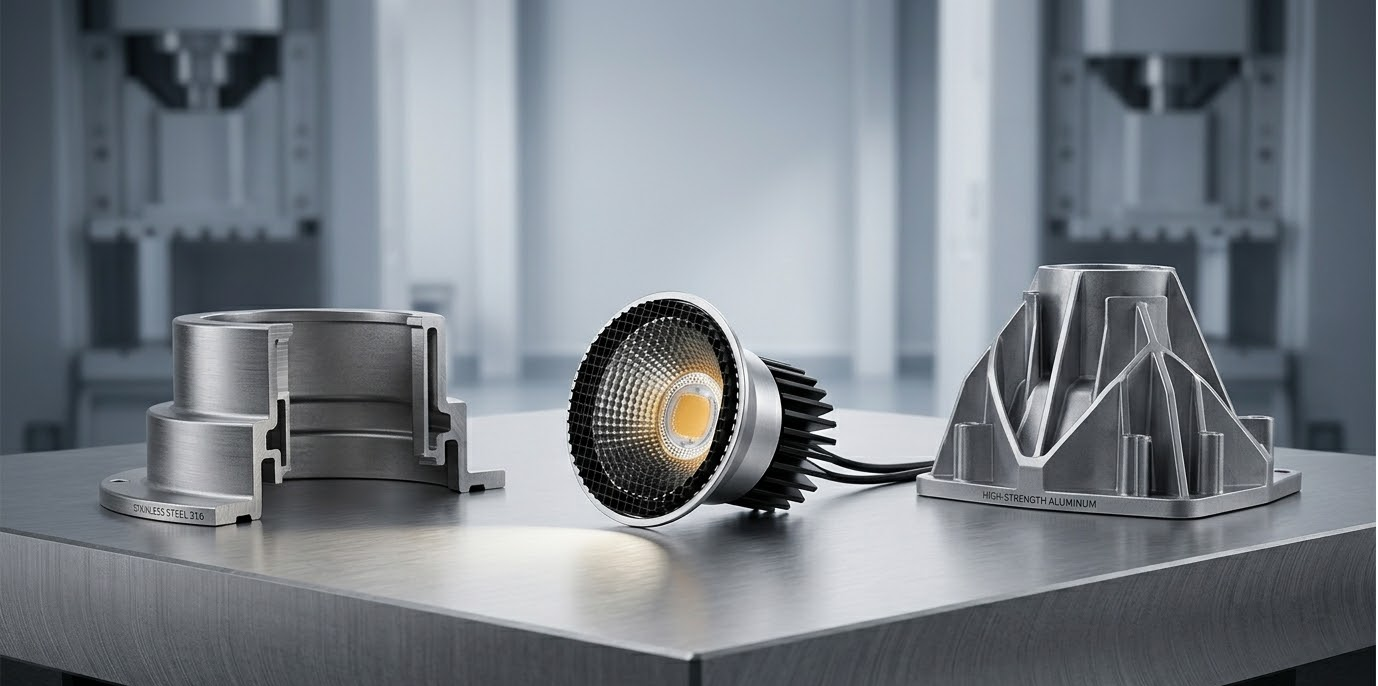
Thermal management is often the point of failure for compact cabinet lights. We addressed this through material science. Leveraging our deep expertise in die-casting aluminum, we designed the 3W housing to act as a highly efficient heat sink. This effective thermal transfer ensures the LED chip operates strictly within its optimal temperature window. It prevents the chromatic shift and lumen depreciation that plague inferior products. For the commercial contractor guaranteeing a ten-year lifespan, this reliability is not a feature. It is an insurance policy.
Anova: The Technical Backbone of Global Lighting
Twenty Years of ODM Mastery
Since 2003, Anova Lighting has never aimed to be a mere supplier. We operate as the technical backbone for the world’s most demanding lighting brands. With two decades of experience navigating the regulatory and aesthetic complexities of the European, Australian, and North American markets, we offer certainty. Not just products.
Our manufacturing facility operates under a rigorous ISO9001:2015 quality management system. This is not a box-ticking exercise. It is the guarantee that every fixture leaving our loading dock meets stringent international safety and performance standards.
Validated by Data: The Anova Lighting Lab
Trust is built on empirical data. That is why we invested capital into the Anova Lighting Lab. In this facility, we do not guess; we test. We conduct exhaustive photometric analysis, thermal stress testing, and accelerated salt spray evaluations. For our Australian partners managing projects in coastal zones—where saline air is a relentless corrosive force—our corrosion resistance data ensures our aluminum housings survive the environment. We hold over 50 national and international patents, including specific utility models for heat dissipation structures. These are not marketing gimmicks. They are the engineered reasons our products outlast the competition. Verify our credentials on our certifications page.
Sustainability as an Engineering Principle
In a market where environmental credentials can win or lose a tender, Anova provides a distinct advantage. We are pioneering the industrial application of recycled ocean plastics, specifically harvesting discarded maritime fishing nets for use in our fixture components. This is not greenwashing. It is a material innovation transforming hazardous marine waste into durable, high-performance housing. By integrating these materials into your supply chain, you help developers meet green building standards and LEED certifications. You align your projects with the inevitable future of sustainable construction.
Conclusion
In the unforgiving arena of luxury Australian design, lighting is the variable determining the success of the aesthetic intent. The integration of high-CRI sources, exemplified by our 3W Adjustable Cabinet Light, offers a solution that respects the integrity of premium materials while satisfying the rigorous technical demands of installation and safety. Partnering with Anova provides access to a supply chain built on manufacturing precision, rigorous data validation, and material innovation. Do not compromise your finishes with inferior light.
Elevate Your Next Project
Demand precision. Ensure your designs are perceived in their absolute best light. Contact Anova today to request a wholesale catalog or apply for a sample of our 3W Adjustable Cabinet Light. Let our engineering team help you bring your architectural vision to life with precision and quality.
FAQs
Q: Why is a 12V DC input the superior choice for residential kitchen joinery?
A: Safety and form factor are the primary drivers. 12V DC is a low-voltage standard that significantly mitigates the risk of electrical shock, a paramount concern in wet kitchen environments. Physically, it allows for the use of ultra-thin cabling and miniature connectors, enabling the fixture to be integrated into joinery without carving out large, destructive channels that compromise structural strength. Additionally, when paired with a quality driver, 12V DC systems offer smoother dimming curves than direct-mains alternatives.
Q: How does the adjustability of the 3W cabinet light alter the spatial perception of a kitchen?
A: Adjustability introduces precision. A static downlight washes the floor indiscriminately. An adjustable optic allows the designer to target the beam onto vertical surfaces—like a tiled splashback or joinery display—which reflects light back into the room, increasing perceived volume. It also allows the beam to be angled away from the user’s line of sight, reducing glare and creating a sophisticated, high-contrast visual hierarchy that emphasizes texture over flat illumination.
Q: Is Anova capable of executing custom specifications for large-scale developments?
A: Absolutely. ODM and customization are our core competencies. Since 2003, we have supported global clientele with bespoke manufacturing. Backed by our internal R&D team and extensive patent portfolio, we have the capability to modify beam angles, adjust color temperatures, and tailor finishes to meet the exact specifications of large-scale commercial or residential tenders. We provide the precise engineering solution required, not just a “close enough” stock product.