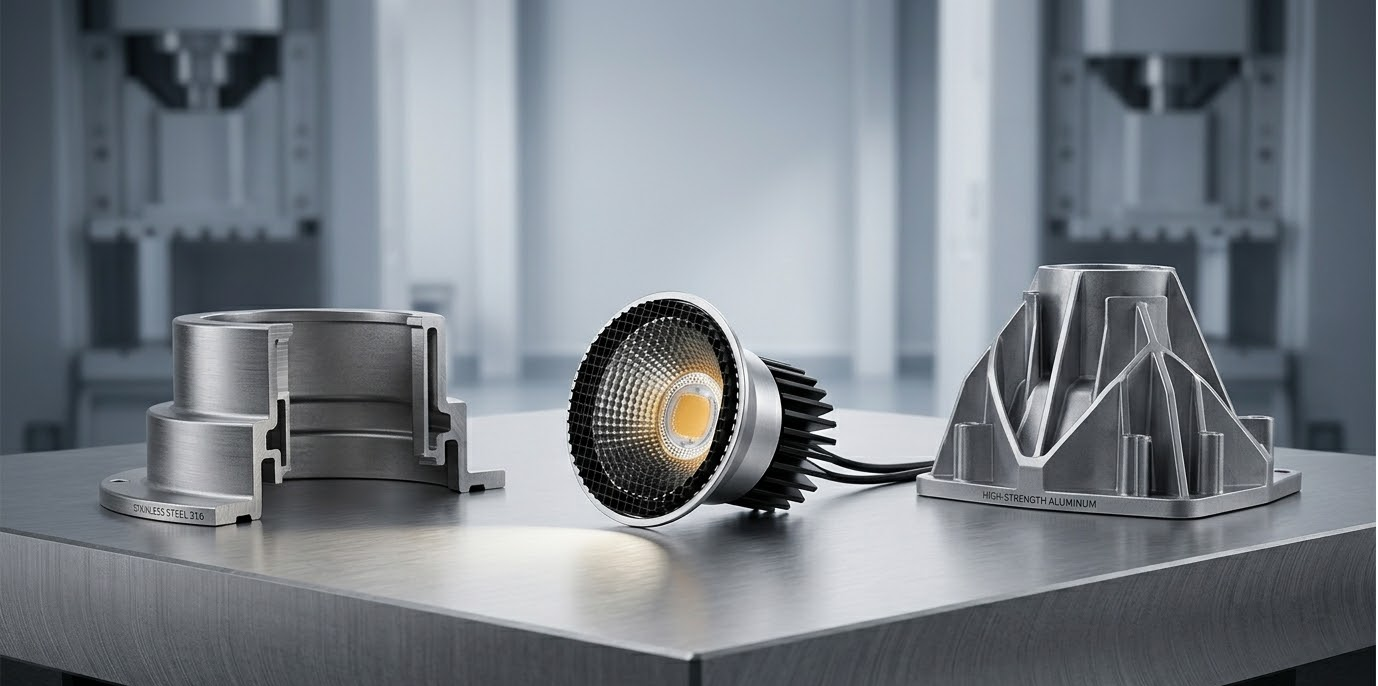
For architectural lighting distributors and engineering contractors working in coastal environments, sourcing dependable IP-rated outdoor lighting or marine-grade luminaires appears to be an ongoing problem. The “tropical paradise” look often belies the harsh truth for hardware products, including corrosion from salt spray. Empirical evidence of the problem is visible in seaside resorts such as high-end beachfront hotels or villas, where high-end metal downlight trims installed months ago display tell-tale signs of pitting, bubbling, and rusting.
This is not merely an aesthetic failure; it is a financial hemorrhage. For importers and wholesalers, premature corrosion leads to warranty claims that erode profit margins. For contractors, it results in reputation-damaging callbacks. In high-humidity environments where the air carries a heavy saline load, relying on traditional powder coating over aluminum is often a losing battle. The ultimate “surface treatment” is not a coating at all—it is a fundamental shift in material innovation.
The Science Behind Salt Spray Corrosion in Traditional Lighting
In order to choose the correct inventory for the coastal market, it is imperative to understand why standard fixtures fail. Aluminum, for example, which is the standard for heat sinks and trims, is a naturally reactive material. While manufacturers use a powder coating to protect the material, the coastal environment is a constant electrochemical attack known as galvanic corrosion.
Salt crystals are hygroscopic, meaning they attract moisture from the atmosphere and form a conductive solution of electrolytes on the fixture’s surface. This solution seeps into small pores and minor scratches in the paint, which usually occur during the installation process. Once the salt water comes in contact with the base metal, “filiform corrosion” occurs—a rust-like substance that spreads underneath the paint and bubbles it off.
Even standard fixtures labeled “marine grade” often rely on the integrity of this thin surface layer. In our internal testing at the Anova Lighting Lab, we have observed that standard die-cast aluminum fixtures, even with high-quality painting, frequently show signs of oxidation after 24 to 48 hours in continuous salt spray chambers. For a project located within 5 kilometers of the coastline, the atmospheric salt content is sufficient to replicate these conditions over months, turning a sleek lighting design into an eyesore.
The Anova Solution: Engineering the Invisible Shield
Instead of relying on generic coatings, Anova focuses on the chemical and physical transformation of the fixture’s surface, integrating circular economy principles right from the design phase. Our approach to extreme-environment lighting centers on three pillars of high-definition (HD) craftsmanship:
1. Advanced Stainless Steel Passivation
While true 316 stainless steel downlights are a gold standard for coastal durability, they must be treated correctly to survive. For our premium coastal ranges, we utilize high-grade stainless steel treated with an advanced Passivation Process.
- How it works: We use a specialized chemical bath to remove exogenous iron from the surface, enhancing the protective chromium-oxide layer.
- The Result: A chemically inactive surface. It doesn’t just “resist” corrosion; it lacks the free iron necessary for rust to even begin.
2. Precision Polishing & Ultra-Smooth Finishes
Corrosion often starts in microscopic “valleys” on a metal’s surface where salt can sit.
- The Anova Craft: Our fixtures undergo multi-stage mechanical polishing to achieve a mirror-smooth or refined satin finish.
- The Benefit: By reducing surface porosity, salt and moisture struggle to gain a foothold, allowing the fixture to “self-clean” more effectively during maintenance or rain.
3. Structural Innovation: Screwless Front Faces
Traditional fixtures often fail at the screw points—where the coating is broken.
- Magnetic Integrity: Many of our designs utilize a patented magnetic structure. By eliminating external screws on the front ring, we remove the primary entry point for moisture and galvanic corrosion.
Spotlight Solution: The Versatile Magnetic 3CCT LED Downlight (DL61601H)

The DL61601H represents the convergence of our surface mastery, modular engineering, and sustainable design, created to solve the dual challenges of durability and inventory management.
Strategic Benefits for Wholesalers
- Inventory Agility: Stocking multiple finishes across various color temperatures leads to bloated inventories. With the DL61601H, you stock the core “Universal Light Engine” and separate magnetic rings (available in 316 Stainless, Passivated, or Polymer).
- Slash SKU Complexity: Cut your inventory variants in half. This modularity frees up trapped capital and dramatically simplifies your warehouse management, all while allowing you to offer high-end customization.
Operational Benefits for Contractors
- “Zero-Damage” Installation: Contractors can install the IP44-rated light engine during the rough-in phase. The delicate, high-finish front rings are snapped into place magnetically only after the site is clean and painted, preventing damage during construction.

- On-Site Calibration: The integrated 3CCT Switch (3000K/4000K/5000K) allows for instant ambiance adjustments. If a client requests a change in warmth, you can recalibrate in seconds without removing the fixture from the ceiling.
Performance for Designers & Owners
- Never-Rust Aesthetics: The screwless design ensures a clean-face aesthetic that stays pristine. Without screw holes to trap salt, the visible trim remains free of the “rust weeping” common in coastal installations.
- Professional Specs: Delivering 920 lumens at 9W with a UGR < 19 rating, it provides the glare-free, high-comfort illumination required by international hospitality standards.
Technical & Environmental ESG Impact: Beyond Durability
At Anova, performance is measured by more than just rust resistance; it’s about aligning with global sustainability standards to help you win projects. The DL61601H utilizes materials certified under the Recycled Claim Standard (RCS) 2.0.
Win high-value LEED and BREEAM bids: This verified traceability empowers developers to earn critical green building certification points, giving you a decisive competitive edge in the bidding process.
Beyond the housing, our light engines deliver high luminous efficiency (up to 120-150lm/W), significantly reducing embodied carbon over the fixture’s 25,000+ hour lifespan. Furthermore, the 3CCT functionality supports Human-Centric Lighting, enhancing the health and well-being of end-users by offering tunable white light for alertness (5000K) or relaxation (3000K).
Beyond the Product: Quality Validated by Data
Based in Foshan, Anova offers High-Definition (HD) Customization backed by our ISO 9001:2015 certified lab:
- Salt Spray Testing: Proving long-term resilience for coastal applications.
- Patented Design: Over 50 patents, including our magnetic quick-change structure.
Conclusion
In high-humidity environments, a fixture is only as strong as its surface. While others offer “paints,” Anova offers metallurgical integrity and material innovation. By selecting passivated, modular, and precision-polished solutions like the DL61601H, you deliver projects that withstand the test of salt and time.
Ready to upgrade your portfolio with corrosion-resistant solutions?
[Download the Full Specification Sheet & IES Files]
[Request a Bespoke Sample for Your Next Coastal Project]
FAQ
Q: Why is passivation better than thicker paint?
A: Paint is a physical barrier that can be scratched. Passivation is a chemical change to the metal surface itself, creating a self-healing layer that remains effective even if the surface is lightly abraded.
Q: Is DL61601H good enough to be used in bathrooms where the atmosphere is relatively damp?
A: To start with, the IP44 rating for DL61601H ensures that it will not suffer any damage if water splashes on the fixtures in a damp atmosphere-like bathrooms. Secondly, with rustproof recycled plastic covering to the front ring, the DL61601H is a great specification in bathrooms, kitchen areas, and spa environments.
Q: Does the ring style compromise the lifespan of the fixture?
A: Actually, the opposite is true: our patented magnetic interchangeable ring style vastly improves the service life of the fixture. The absence of screws on the trim is great, as the screws are the first place rust forms on metal-trimmed lighting fixtures. By being tool-free, the style can be easily updated to give the fixture an extended lifespan while keeping the ceiling installation looking pristine.