In high-value commercial lighting projects, every step from design to installation affects cost, performance, and long-term maintenance. Choosing the wrong housing material can lead to poor heat dissipation, faster lumen depreciation, more frequent failures, and unnecessary service calls. In practice, material selection is not just about appearance. It directly shapes fixture lifespan, installation efficiency, and overall return on investment. Understanding how each material performs under real operating conditions is critical to making the right specification.
Evaluating Core Materials: Aluminum, Plastic, and Stainless Steel
Choosing the right housing material means weighing thermal performance, structural strength, weight, corrosion resistance, and cost. Aluminum, plastic, and stainless steel can all be used in lighting, but they perform very differently in demanding commercial environments.
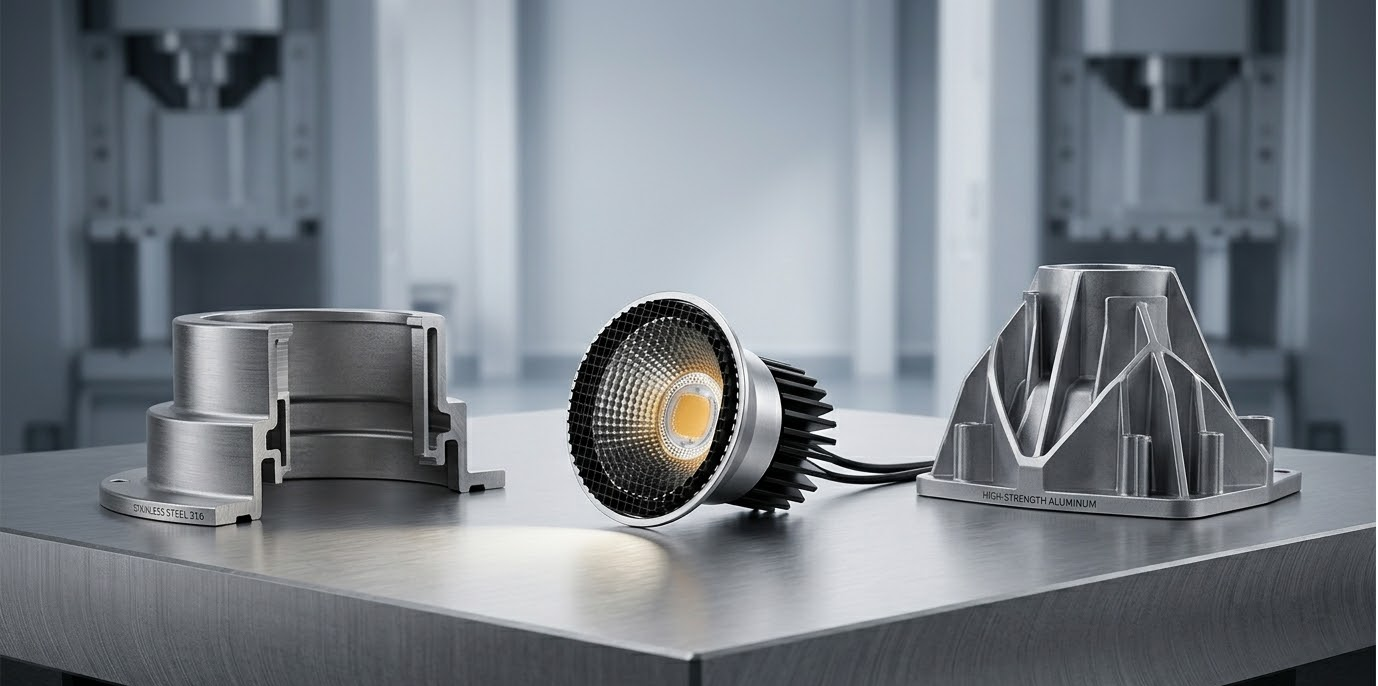
Standard plastic is often utilized for its low cost and lightweight nature. However, for core light sources, standard plastic possesses exceptionally poor thermal conductivity. It cannot efficiently draw heat away from high-power LED chips. Over time, trapped heat causes the plastic to warp, degrade, and accelerate the failure of the luminaire. While specialized eco-friendly plastics are excellent for decorative outer housings, they are not suited for the core thermal management of high-output modules.
This property of stainless steel provides an alternate profile of characteristics. It provides substantial structural properties with superior corrosion resistance, thus contributing to its strong visual impact. However, it comes with substantial disadvantages for lighting purposes. The substantial weight of the material makes ceiling installation challenging and increases freight costs for importers. Most importantly, the thermal conductivity of the material is significantly lower than aluminum, leading to heat retention rather than heat dissipation, which is harmful to LEDs.
Die-casting aluminum emerges as the ultimate choice for premium light fixtures. It strikes the perfect balance for the lighting industry. Die-casting aluminum offers exceptional thermal management, rapidly pulling heat away from the LED core. It delivers high structural strength while remaining lightweight. For wholesalers, the premium surface texture of die-cast aluminum elevates the perceived value of the product, ensuring higher market competitiveness. For contractors, its lightweight nature simplifies installation, while its durability guarantees zero callbacks due to heat-induced failures.
Die-Cast Aluminum Thermal Management: How to Prevent LED Lumen Depreciation and Extend Service Life
The advantage of die-cast aluminum is easy to verify in real product testing. In our lighting lab, aluminum fixtures go through photometric analysis, salt spray testing, and extreme temperature simulations. These evaluations help confirm stable thermal performance and structural reliability, including in harsh or humid environments when configured to IP65.

This engineering focus is supported by practical innovation. We hold over 50 national patents, including a utility model patent for a heat-dissipating housing structure. That design uses the natural thermal conductivity of die-cast aluminum to improve airflow and cooling efficiency. By keeping LED chips within a more stable operating temperature range, it helps reduce premature lumen depreciation and supports more consistent long-term performance. For brand owners and contractors, that means lower failure risk and a lighting system that stays reliable over time. You can view our verified credentials through our Certifications.
Precision Meets Durability: The 10W Tunable White 24V DC COB LED Module
A strong example is the 10W Tunable White 24V DC COB LED Module, which shows how die-cast aluminum supports thermal control, durability, and installation flexibility in a compact format.
Constructed entirely from premium die-casting aluminum, this module stands at a compact 70mm in height, providing a robust yet space-saving profile. It delivers a luminous flux of up to 908 lumens and features an advanced tunable white technology (2700K to 6500K), boasting a Color Rendering Index (CRI) greater than 90. Furthermore, it offers precise optical control with adjustable beam angles of 15°, 24°, 36°, and 60°.
The benefits of this aluminum-bodied module are tailored to specific business needs. For importers, the compact and lightweight aluminum design significantly optimizes shipping volume and costs. For wholesalers, the tunable CCT feature reduces inventory pressure, as one module can satisfy multiple color temperature demands. For engineering contractors, the availability of both IP20 and IP65 ratings ensures that this module can be deployed flawlessly in both dry indoor spaces and humid outdoor environments, such as luxury hotel bathrooms or exterior corridors. The die-cast aluminum heat sink guarantees that the module will operate safely and brilliantly for years.
Partnering with Anova: Your Reliable Wholesale Lighting Manufacturer
Rooted in Foshan, Guangdong—China’s renowned “City of Lighting”—since 2003, Anova has established itself as a pioneer in ODM design and a premier lighting wholesaler. We are a sustainable integrated supply chain service provider for professional lighting distributors in Europe, Oceania, the Middle East, and Asia. Our guiding philosophy, “Professionalism Creates Value,” is the foundation for all stages of our production process.
Our manufacturing excellence is anchored by a structured four-step quality process aligned with ISO 9001:2015 standards. Following a significant Factory Tour and facility upgrade in late 2023, we have further bolstered our automated production machinery and specialized workshops. We partner with industry-leading material suppliers like Bridgelux, OSRAM, PHILIPS, and CREE. This rigorous quality control allows us to confidently provide a comprehensive 5-year warranty across all product lines. Furthermore, our dedicated after-sales team is committed to providing actionable solutions within 8 hours of contact, ensuring your business operations are never disrupted.
Conclusion
The material used in a luminaire has a direct impact on thermal performance, service life, maintenance frequency, and project cost. Plastics and stainless steel still have their place in certain applications, but for core thermal management in commercial LED fixtures, die-cast aluminum remains the strongest all-around option. For importers, specifiers, and contractors, choosing the right material is one of the simplest ways to reduce heat-related failures, avoid premature replacement costs, and protect long-term ROI.
Elevate Your Projects with Premium Aluminum Lighting
Securing the right lighting partner ensures that your projects shine with unparalleled quality and reliability. We are ready to support your market expansion with precision-engineered, aluminum-based LED solutions.
[Download the full technical specifications and IES files for our Aluminum LED Modules]
[Apply for samples for your next high-value project to test our thermal management firsthand]
Please visit our Contact Us page today to receive a free product catalog and discuss customized lighting solutions tailored to your specific market demands.
FAQ
Q: Why is die-casting aluminum considered the best material for commercial LED modules?
A: Die-cast aluminum possesses higher thermal conductivity than plastics and stainless steel. It helps in the dissipation of heat from high-powered LEDs, thus preventing the degradation of emitted light, sustaining luminous efficiency, and extending the lifespan of the fixture.
Q: How does the tunable white feature of the 10W COB LED Module benefit lighting wholesalers?
A: This tunable white feature enables the device to operate at any temperature between 2700 K and 6500 K. This reduces the pressure on the wholesalers as they would not need to purchase the different modules at the different temperature ranges of 2700 K, 3000 K, and 4000 K to cater to the different needs of the customers.
Q: Can the aluminum-based 10W LED module be installed in humid environments?
A: Indeed. This is due to the fact that its construction is robust and made of die-cast aluminum, which guarantees the sealing capabilities. This implies that it has the IP65 variant, which guarantees the best functionality in adverse conditions such as bathrooms and eaves due to its dust and water resistance capabilities.