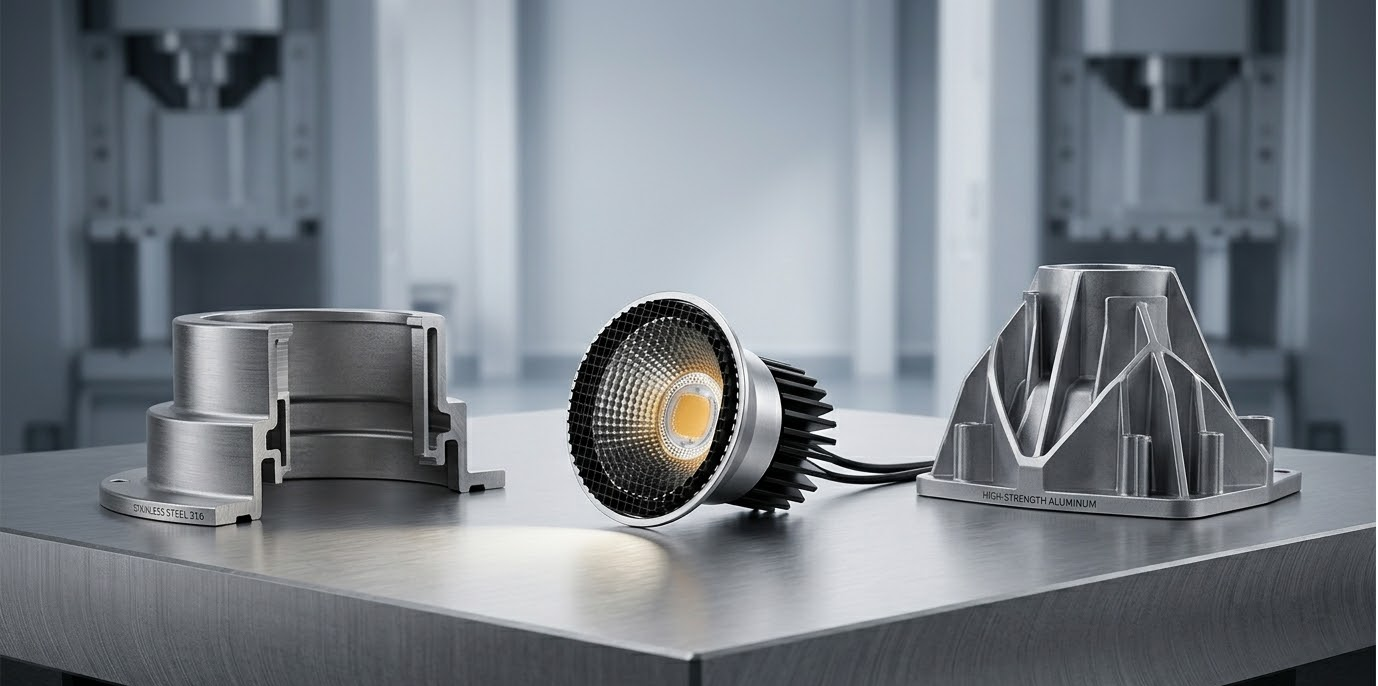
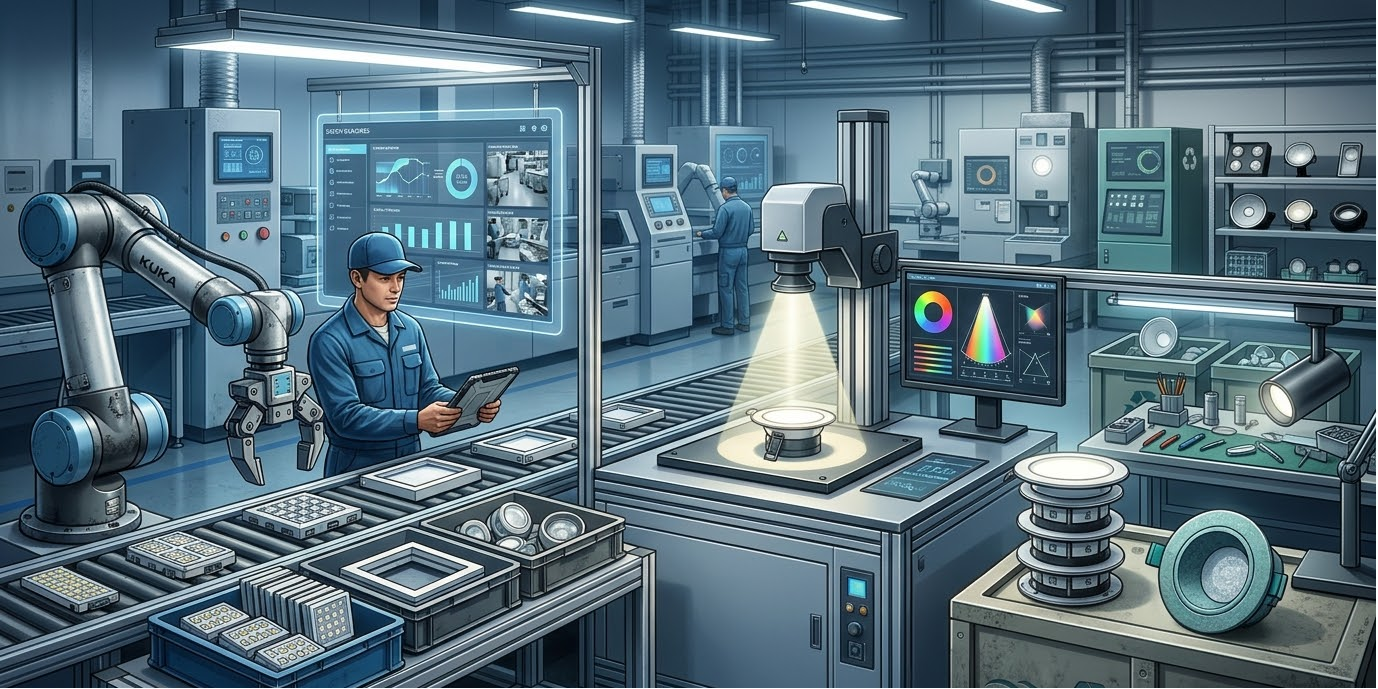
In the professional lighting sector, genuine innovation is defined by its ability to generate significant operational and financial advantages. The industry is currently transitioning from incremental product enhancements to a new paradigm of efficiency, driven by the Modular Downlight. This is a strategic lighting platform engineered on a foundational principle: the decoupling of the high-performance light engine (the “Core”) from the architectural fixture housing (the “Shell”).
Redefining Lighting Procurement and Management with a “Core” and “Shell” Architecture
This is not merely a new product line; it is a re-engineered business process for lighting professionals. By establishing the Core and Shell as two distinct, interchangeable assets, the modular architecture enables B2B clients to fundamentally optimize their supply chain, mitigate financial risk, and achieve a level of project flexibility previously unattainable.
The “Core”: A Standardized Hub of Lighting Performance
The “Core” represents the technological heart of the system, where the primary investment in lighting performance is concentrated. It is a self-contained, high-efficacy LED module, such as our MR16 series, designed and manufactured for superior illumination, reliability, and technical compliance.
The Technical Specifications of a High-Performance “Core”
The “Core” is an assembly of advanced lighting technologies, available in multiple configurations to meet precise project demands. Key options include:
- 3CCT Switched Core: This 3CCT module offers ultimate on-site versatility through 3CCT switchability, allowing a single unit to be configured for three distinct color temperatures (e.g., 3000K, 4000K, 5000K). This feature drastically reduces the number of SKUs required to serve a wide range of applications.
- Tunable White Core: For projects requiring maximum flexibility and dynamic lighting, we offer modules like the 2700-6500K Tunable White 7W MR16 LED Module. This type of core provides a continuous spectrum of color temperatures, perfect for human-centric lighting and seamless integration with modern smart control systems for advanced dimming, scheduling, and automation.

Both Core types maintain a high Color Rendering Index (CRI >90) to ensure color fidelity in critical applications and incorporate sophisticated thermal management to guarantee a long operational lifespan.
The “Shell”: A Framework for Design, Application, and Sustainability
The “Shell” serves as the architectural interface of the fixture. Its function is to define the aesthetic integration, application-specific requirements, and physical form factor of the downlight.
The Strategic Value of a Green OBP “Shell”
Our Shells, such as the 68mm Cutout MR16 Downlight Housing, are engineered for maximum adaptability and cost efficiency. A significant portion of our portfolio is constructed from sustainable Ocean-Bound Plastic (OBP), providing a lightweight yet durable and eco-friendly solution. Shells are available in a comprehensive array of finishes, apertures, and technical styles, including trimless and low-glare variants. As the high-cost technology resides within the Core, the Shell is a low-unit-cost, high-volume component, permitting extensive design diversification without significant capital outlay.

Key Advantages for B2B Professionals
The modular architecture directly addresses the critical operational and financial challenges faced by lighting industry professionals, delivering quantifiable value at each stage of the supply chain.
For Wholesalers & Distributors: An Inventory Revolution
This platform enables a paradigm shift in inventory management. The traditional linear logic—where one 3CCT fixture replaces three SKUs—is superseded by an exponential model. Distributors no longer need to maintain extensive stock of finished fixtures. Instead, they can hold a consolidated inventory of high-value “Cores” and a broad, low-cost inventory of “Shells.” For example, a holding of just 3 Core SKUs and 10 Shell SKUs can yield 30 unique finished product configurations. This constitutes a strategic reduction in inventory holding costs and an enhanced capacity to meet diverse market demands.
For Engineering Contractors & Builders: Enhanced On-site Execution and Risk Mitigation
The modular system is engineered for the dynamic environment of a construction site. Last-minute design changes, such as a revision to the trim color, can be accommodated by simply exchanging the Shell, thereby eliminating the need for costly and time-consuming re-procurement of entire fixtures. This agility de-risks the installation process and improves project timelines. Furthermore, the serviceability model—replacing only the Core in the event of failure—offers substantial long-term maintenance benefits.
For Interior Designers & Architects: Decoupling Technical Performance from Aesthetic Specification
The modular framework resolves a long-standing conflict in the specification process. It allows for the complete decoupling of performance-based and aesthetic-based decisions. Designers can first select a “Core” that meets the precise photometric requirements of a space, and subsequently specify a “Shell” that aligns perfectly with the architectural vision. This guarantees both technical integrity and design fidelity without compromise.
For Real Estate Developers & Property Management: Future-Proofing and Asset Value Enhancement
A modular downlight system is a long-term capital investment that enhances asset value. The ability to upgrade a building’s lighting technology by replacing only the “Core” module—while leaving the existing ceiling and housing intact—provides a significant financial advantage over the asset’s lifecycle. This “future-proofing” capability drastically reduces the total cost of ownership (TCO) and ensures the property remains competitive.
Your Trusted Partner in Lighting Innovation: Anova Lighting
As a premier lighting wholesaler with origins in Foshan since 2003, Anova Lighting is dedicated to providing our global B2B clientele not with products, but with strategic business solutions. Our commitment to the modular philosophy is substantiated by over 50 patents and a rigorous ISO 9001:2015 certified quality management system.
Conclusion
The Modular Downlight represents a strategic evolution in lighting systems. The “Core and Shell” architecture provides a definitive solution to the industry’s most pressing challenges regarding inventory management, project flexibility, and long-term asset value. It is a system designed for mutual benefit across the supply chain, delivering a clear competitive advantage to all stakeholders. This is not merely a smarter product; it is a more intelligent and profitable business model.
FAQs
Q1: How does the modular system impact the total cost of ownership (TCO) compared to conventional fixtures?
A: The TCO for a modular system is significantly lower. While initial acquisition costs may be comparable to high-quality conventional fixtures, substantial savings are realized through: 1) reduced inventory capital and carrying costs for distributors; 2) mitigated re-procurement and labor expenses for contractors; and 3) the long-term financial benefit of upgrading only the light engine (“Core”) instead of the entire luminaire, thus preserving the initial investment in housing and installation.
Q2: What is the reliability and security of the “Core” to “Shell” interface?
A: The interface mechanism, whether magnetic or mechanical, is precision-engineered to ensure a stable, secure, and reliable connection. It guarantees both flawless aesthetic integration and consistent electrical continuity. The design has passed extensive testing protocols to certify its long-term durability and performance, even under repeated service or upgrade cycles.
Q3: What is the scope of compatibility between Core and Shell models?
A: The system is designed to provide extensive compatibility within designated product families (e.g., MR16 platform). This architectural principle enables a high degree of product customization. For example, a specifier can pair a high-performance 3CCT Core with an IP-rated Shell for wet environments, or with a trimless architectural Shell for a high-design application. This provides an unparalleled level of control over the final product specification from a limited set of core components.